খালেদা জিয়া: মৃত্যুর পরও যে মানবিক ঐক্যের ছবি বাংলাদেশ দেখল
বাংলাদেশের রাজনীতি সাধারণত বিভাজনের ভাষায় কথা বলে। ক্ষমতা ও বিরোধিতা মুখোমুখি, কণ্ঠে তিক্ততা, স্মৃতিতে সংঘাত। কিন্তু ৩১ ডিসেম্বর ২০২৫, খালেদা জিয়ার জানাজার সেই মুহূর্ত সব চেনা বাস্তবতাকে থামিয়ে দিল। সামাজিক মাধ্যমে ছড়িয়ে পড়া ছবিতে দেখা যায় একই কাতারে দাঁড়িয়ে আছেন রাজনৈতিক প্রতিপক্ষ, আইনশৃঙ্খলা বাহিনী, সামরিক ও বেসামরিক সদস্যরা। কাঁধে কাঁধ মিলিয়ে, কোনো স্লোগান নেই, কোনো দলীয় ব্যানার নেই শুধু নীরবতা ও প্রার্থনা।
যেমন প্রথম নজরে এই দৃশ্যটি শুধু জানাজার মুহূর্ত মনে হয়, কিন্তু গভীরভাবে দেখলে এটি হয়ে ওঠে বাংলাদেশের জাতিসত্তার একটি বিরল প্রতীক। খালেদা জিয়া শুধু একজন সাবেক প্রধানমন্ত্রী নন; তিনি একাধিক রাজনৈতিক যুগের সাক্ষী সামরিক শাসন-পরবর্তী গণতন্ত্র, তীব্র দলীয় বিভাজন এবং দীর্ঘদিনের প্রতিদ্বন্দ্বিতা। তাঁর জানাজার কাতারে যখন রাজনৈতিক প্রতিপক্ষরা পাশাপাশি দাঁড়ান, এটি কোনো সমঝোতার ঘোষণা নয়। বরং এটি একটি নীরব স্বীকৃতি, যে মৃত্যু রাজনীতির চেয়েও বড়, এবং কিছু মুহূর্তে বিভাজন স্থগিত থাকে। এই দৃশ্য পাঠককে শেখায়, মানবতার মূল্য রাজনৈতিক পরিচয় থেকে অনেক উপরে। বিভাজনের চেয়ে মানুষের শ্রদ্ধা বড়।
খালেদা জিয়ার রাজনৈতিক জীবনের বিতর্ক ও উত্তাপ স্বাভাবিকভাবেই প্রত্যাশিত ছিল, কিন্তু কাতারে সেই উত্তাপ দেখা যায়নি। যারা একে অপরের কঠোর সমালোচক, তাঁরা দাঁড়িয়েছিলেন পাশাপাশি। কেউ কারও দিকে আঙুল তুলছিল না, কেউ কারও দিকে তিক্ত চোখে তাকাচ্ছিল না। শুধু নীরব শ্রদ্ধা ও প্রার্থনা। এই মুহূর্ত পাঠককে শেখায় যে শক্তি এবং প্রতিদ্বন্দ্বিতার মধ্যে মানবিক উদারতা বজায় রাখা সম্ভব।
জানাজার মাঠে সাধারণ মানুষের কণ্ঠে বিস্ময় ও প্রশান্তি লক্ষ্য করা গেছে। একজন বলেন, “আমরা তো অভ্যস্ত সংঘাত দেখতে, কিন্তু আজ সবাই একসঙ্গে দাঁড়িয়েছে। এই দৃশ্যটা আগে দেখিনি।” এখানেই এই ঘটনার মানবিক গুরুত্ব। রাজনীতি যেখানে বিভাজন তৈরি করে, শোক মানুষকে এক করে। পাঠক উপলব্ধি করতে পারে, মানুষের সেরাটা আসে সাময়িক হলেও বিভাজন ভুলে একত্রিত হলে। এটি মৌলিক মানবিক শিক্ষা—যেখানে মানুষ একে অপরের জন্য ভালো হতে পারে।
এক কাতারে দাঁড়ানো প্রতিপক্ষেরা
জানাজার কাতারে দাঁড়িয়ে ছিলেন দেশের ভিন্ন রাজনৈতিক ধারার নেতারা ড. মুহাম্মদ ইউনুস, তারেক রহমান, ডা. শফিকুর রহমান, মির্জা ফখরুল ইসলাম আলমগীর, মিয়া গোলাম পরওয়ার, নাহিদ ইসলামসহ আরও অনেকেই।
এই দৃশ্যটি পরিকল্পিত ঐক্যের ছবি নয়। বরং এটি ছিল পরিস্থিতির স্বাভাবিক ফল যেখানে মৃত্যু রাজনীতিকে সাময়িকভাবে নিস্তব্ধ করে দেয়।
বাংলাদেশের রাজনৈতিক সংস্কৃতিতে, যেখানে বিভাজন প্রায় স্থায়ী বাস্তবতা, সেখানে এমন এক কাতার প্রশ্ন তোলে— আমরা কি সত্যিই কেবল বিভক্তই, নাকি প্রয়োজনে একসঙ্গে দাঁড়ানোর ক্ষমতাও আমাদের আছে ?
সবচেয়ে লক্ষণীয় ছিল বাহিনীর উপস্থিতি। বাংলাদেশে রাষ্ট্রযন্ত্র প্রায়ই রাজনৈতিক চশমায় দেখা হয়। কিন্তু সেই দিন বাহিনীর সদস্যরা দাঁড়িয়েছিলেন একজন মানুষের মৃত্যুতে নিরপেক্ষ ও মানবিক শ্রদ্ধা প্রদর্শনে, রাষ্ট্রীয় পরিচয় বা রাজনৈতিক পরিচয় ছাড়াই। পাঠক শিখতে পারে, ক্ষমতা মানেই কর্তৃত্ব নয়; মানুষের প্রতি সম্মান প্রদর্শন করাও ক্ষমতার নিদর্শন।
জানাজার মাঠে সাধারণ মানুষ ছিলেন রাজনৈতিক পার্থক্য ভুলে। কেউ ভোট দিয়ে ছিলেন, কেউ না। কেউ এসেছিলেন দায়িত্ববোধে, কেউ কৌতূহলে, কেউ কেবল শোক জানাতে। এই উপস্থিতি মনে করিয়ে দেয় যে মানবিক অনুভূতি রাজনৈতিক পরিচয়ের চেয়ে শক্তিশালী।
বাংলাদেশের ইতিহাসও বহুবার দেখিয়েছে যে, যখন মানবিক বা জাতীয় সঙ্কট আসে, মানুষ একত্রিত হয়। যেমন ওসমান হাদির জানাজা (২০২৫), ২৪-এর ছাত্র আন্দোলন (৫ আগস্ট ২০২৪), ১৯৭১-এর মুক্তিযুদ্ধ, ১৯৯০-এর গণঅভ্যুত্থান সব ক্ষেত্রেই দেখা গেছে মানুষ পার্থক্য ভুলে একসাথে এসেছে। প্রাকৃতিক বিপর্যয় বা ত্রাণ সংকটের সময়ও মানুষ রাজনৈতিক পরিচয় অগ্রাহ্য করে সহায়তা করেছে। এই জানাজার মুহূর্তও সেই ঐতিহ্যের অংশ, যেখানে রাজনৈতিক নেতারা, বাহিনী ও সাধারণ মানুষ একত্রিত হয়ে মানবিক শ্রদ্ধা প্রদর্শন করেছে।
বিশ্ব রাজনীতিতেও এমন দৃশ্য বিরল নয়। নেলসন ম্যান্ডেলার জানাজায় দক্ষিণ আফ্রিকার বিভক্ত রাজনৈতিক শক্তি একত্র হয়েছিল, জাপানে রাষ্ট্রীয় শোকের সময় রাজনৈতিক বিরোধ স্থগিত থাকত। এই মুহূর্তগুলো স্থায়ী ঐক্য নয়, কিন্তু স্মৃতি ও প্রতীক হিসেবে কাজ করে। খালেদা জিয়ার জানাজার কাতারও সেই রকম।
রাজনৈতিক বিতর্ক থাকবেই। কিন্তু খালেদা জিয়ার জানাজার মুহূর্ত মানুষকে শেখায় যে মানুষ একত্রিত হতে পারে, শ্রদ্ধা ও মানবিকতার চেয়ে বিভাজন ছোট। পাঠক অনুধাবন করতে পারে: যদি এমন সূভাগ্য আমার জীবনে হতো, আমি হয়তো নিজেকে আরও ভালো মানুষ হিসেবে গড়তে পারতাম।
সম্ভবত রাজনীতি আবার তার চেনা পথে ফিরবে। বিতর্ক, সংঘাত, অবিশ্বাস থাকবে। কিন্তু প্রতীকগুলো স্মৃতিতে কাজ করে। খালেদা জিয়ার জানাজার কাতার মনে করিয়ে দেয়, বাংলাদেশ চাইলে এক হতে পারে নীরবতায় হলেও। এই দৃশ্য মানবিক ঐক্যের এক বিরল চিহ্ন, যা রাজনৈতিক দল নয়, বরং মানুষের উপর মানুষের শ্রদ্ধা ও ভালোবাসার শিক্ষা দেয়।
খালেদা জিয়ার জানাজা এক মুহূর্তে বাংলাদেশের রাজনীতি ও মানুষের ঐক্য
তারেক রহমান: এক অসম্ভব মুহূর্ত
এই জানাজার আরেকটি গভীর প্রতীকি দিক ছিল তারেক রহমানের উপস্থিতি। একসময় যাঁর কারাবন্দি জীবন, নির্বাসন এবং অনুপস্থিতি বাংলাদেশের রাজনীতির অবিচ্ছেদ্য বাস্তবতা ছিল তাঁর এমন উপস্থিতি একসময় কল্পনাতীত ছিল। কিন্তু সেদিন তিনি ছিলেন। আর তাঁর বক্তব্য ছিল না রাজনৈতিক ছিল মাত্র এক মিনিটের মানবিক উচ্চারণ। মায়ের জন্য ক্ষমা চাওয়া, দোয়ার আবেদন।
এই মুহূর্তটি বাংলাদেশের রাজনৈতিক ইতিহাসে বিরল। ক্ষমতার ভাষা নয়, প্রতিরোধের ভাষা নয় বরং একজন সন্তানের নত কণ্ঠ।
লেখক: তুহিন সারোয়ার। বাংলাদেশি অনুসন্ধানী সাংবাদিক ও আন্তর্জাতিক স্বীকৃত লেখক, যিনি মানবাধিকার, জলবায়ু পরিবর্তন, শিশু শ্রম এবং রোহিঙ্গা সংকট নিয়ে মাঠভিত্তিক ও তথ্যভিত্তিক রিপোর্টিং করেন।
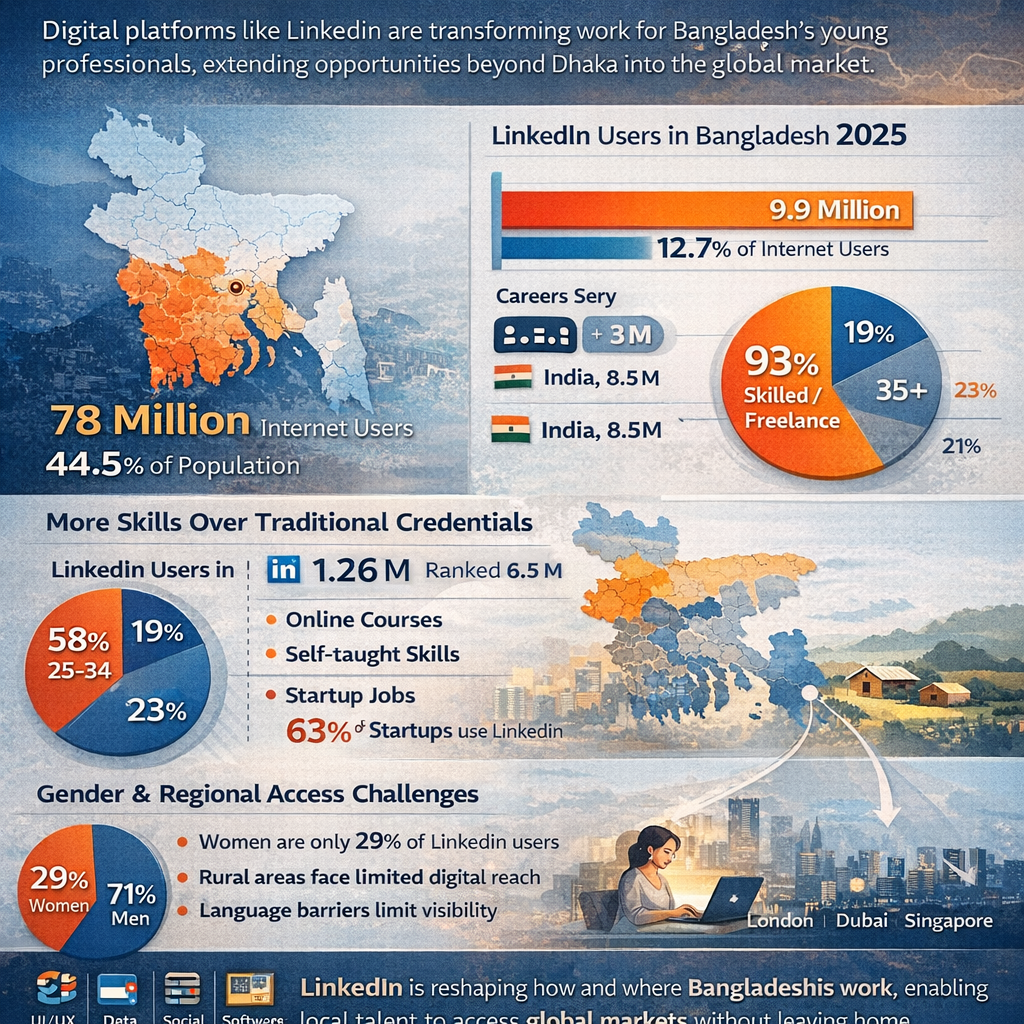
LinkedIn and Bangladesh’s Digital Workforce: A New Global Gateway for Freelancers
The sunrise filter on Rafiya’s laptop glows faintly in her modest Sylhet apartment. Around her, the morning rituals of a middle-class Bangladeshi household play out: the kettle whistles, children’s school bags are zipped, an elder asks about the day’s chores. But Rafiya isn’t heading to a local office. Instead, she logs into LinkedIn from her makeshift desk. Within 15 minutes she has conducted a video chat with a creative director based in Berlin, downloaded feedback on a brand identity brief from Singapore, and submitted three mock-ups for a UK-based client. For her, the world’s gig economy sits in a quiet corner of Sylhet. This scene marks a quieter revolution in Bangladesh: professional identity, income opportunity and labour geography are being reshaped by digital connectivity.
The digital pulse of a nation
Bangladesh’s professional-networking ecosystem is accelerating. According to the platform’s advertising-reach data, LinkedIn’s audience in Bangladesh grew by 1.9 million users (+23.8 %) between early 2024 and early 2025 — reaching about 5.7 % of the total population and 12.7 % of internet users.DataReportal – Global Digital Insights Meanwhile, younger professionals dominate: one snapshot shows 4.9 million users in the 25-34 age bracket in January 2025.Markedium These figures hint at more than social-network growth. They signal an evolution: Bangladesh’s 20-to-34-year-old cohort is increasingly present in global talent pipelines, using LinkedIn not simply to “connect,” but to transact across borders.
A workforce late to the table, now rewriting its rules
For decades, Bangladesh’s growth story leaned heavily on garments and low-cost manufacturing. A recent OECD/UN policy review notes that to achieve more inclusive and sustainable growth, the country must harness digital technologies, expand export capacities and upgrade skills.OECD In parallel, the freelancing wave has surged. A local commentary observes that the country has seen “a significant inflow of foreign currency as freelancers earn from international clients,” bolstering foreign-exchange reserves and diversifying economic structure.The Financial Express One global payment provider lists Bangladesh among the top-10 freelancing countries by income.Payoneer Rafiya’s story is rooted in this transition: she left a modest local design job, up-skilled through online courses, built an Upwork profile, and now services clients globally—all while remaining based in Sylhet. Her laptop replaces a commuter bus; her portfolio replaces a local résumé.
The gender and geography equation
Yet this transformation remains uneven. On LinkedIn, gender disparity persists: only about 29.2 % of Bangladesh’s ad-audience users were female in early 2025.DataReportal – Global Digital Insights In a society where professional opportunity has often concentrated in Dhaka and male-dominated corridors, Rafiya’s emergence from Sylhet is symbolic. Her platform is global, but her context is local: familial expectations, patriarchal norms, variable internet connectivity. Policy-makers are aware of the geography-gender axis. Bangladesh’s digital-economy strategies emphasise “inclusive growth” through digital public infrastructure, rural connectivity and skills training.GEDKP For freelancers like her, the story isn’t simply “remote job” — it’s about visibility. On platforms like LinkedIn, search algorithms, language fluency and digital literacies influence who gets noticed. As one local column warns: “Connectivity without inclusion can reproduce old hierarchies in new digital forms.The Daily Star
Digital exportation: Beyond garments to design
The digital economy is quietly becoming Bangladesh’s next frontier. Though official numbers vary, in forums the government projects the ICT/ITES sector to contribute billions in export revenue by leveraging two-million professionals by 2025.RAPID Bangladesh For freelancers like Rafiya, digital export means earning in USD or euros from clients based in Europe, North America or Asia, then converting to local currency. One report flags that many freelancers only bring 30-50 % of their earnings home, keeping part in foreign financial accounts.The Financial Express Rafiya’s individual portfolio tallies small sums — a £300 logo design, $200 monthly retainer — but the aggregate effect across thousands of such freelancers becomes national: foreign currency earnings flow, new consumption patterns emerge, dependence on traditional sectors softens.
Platform, policy, payment: The infrastructure layer
Behind this surge lies a chain of platforms and policies. LinkedIn connects talent and opportunity. Payment networks like Payoneer collaborate with local actors (e.g., mobile-wallet provider bKash) to streamline cross-border transfers for Bangladeshi freelancers.Payoneer On the policy side, Bangladesh’s “Digital Bangladesh” agenda, and its successor visions for 2041, emphasise digital literacy, infrastructure and service-exports.OECD Yet limitations remain: internet speeds in rural regions lag, English-language proficiency is uneven, local banks and regulatory frameworks are still adapting to global freelancing workflows. For Rafiya, this means she must optimise her LinkedIn profile, engage with global clients during their timezone, and manage payments via a third-party wallet rather than local bank rails.
The meritocracy in practice hope and hazards
On the surface, platforms like LinkedIn promise a meritocratic space: a strong portfolio, creative clarity and time-zone availability — not family connections or local address — determine opportunity. But the data-rich reality is more complex. Algorithms favour profiles with consistent activity. Language and presentation count. And even digital currency vulnerabilities can undermine stability. As thousands of freelancers globally have found, “visibility” remains a commodity. For Bangladesh, this means the growth isn’t automatic equity. A 2024 report warns that without skill upgrades and inclusion strategies, the nation’s freelancing reputation could falter.The Financial Express Rafiya navigates this by doubling down on interface design skills, learning German UX standards, and maintaining 97 % client satisfaction on Upwork. Her success reflects both talent and strategic adaptation.
The regional lens — South Asia’s digital ripple
When compared with neighbours, Bangladesh is catching up fast. India’s LinkedIn base exceeds 100 million, Pakistan’s sits at around 8.5 million, Nepal around 1.2 million. Bangladesh’s own LinkedIn penetration in early 2025 placed it at 6.2 % of population, up from lower levels a year prior.NapoleonCat In the regional labour shift, Bangladesh’s “mobile-first young workforce” becomes a competitive asset. Unlike more saturated markets, its digital freelancing wave is still in mid-expansion, offering growth margins.
Looking ahead: 2030-41 and the smart economy
As Bangladesh sets its sights on 2041, digital labour and skills form a pillar of future strategy. Analysts argue that if aligned with AI-driven work platforms, South Asia could add tens of millions of remote service jobs by the 2030s.World Bank For Rafiya, the next horizon isn’t simply bigger clients, but global brand partnerships, recurring retainers, and digital-native business models. Her journey from Sylhet to a worldwide creative network speaks to more than personal ambition — it mirrors a sweeping structural shift in how South Asian work is configured.
Closing: Redefining professional identity
Back in her apartment, Rafiya closes her laptop. Her day ends not with a commute, but with uploading designs and logging off at midnight European time. The kettle whistles again, but now tasks, emails and deadlines fill the space where once only domestic routines existed. Her mother asks: “What will you do tomorrow?” She replies: “Design a user interface in San Francisco, and a brand book for a start-up in Nairobi.” Her answer captures the trajectory of a country rethinking its labour, geography and economy. Bangladesh is not simply exporting garments now — it’s exporting digital competence. And for its young, mobile, digitally fluent generation, the world is logging in from Sylhet. In the digital labour marketplace of South Asia, a new identity is emerging: professionals whose desks are wherever a laptop and connection can reach — and whose market is global, not just local.
The 21st century’s marked expansion of global inequality, institutional erosion of labor protections, and the intensification of socio‑economic polarization have driven renewed scholarly and policy attention toward left‑wing political economy. This article evaluates historical and contemporary economic ideologies — Marxism, Leninism, Capitalism, Social Democracy, China’s hybrid socialism, and Latin America’s Pink Tide — through both qualitative interpretation and quantitative evidence such as Gini coefficient trends and labor market data. With case studies from Nordic welfare states, China’s developmental trajectory, and Latin America’s redistributive wave, the paper explores how leftist policy interventions have shaped labor rights, equitable distribution, and social justice outcomes within neoliberal contexts. It maintains theoretical neutrality while illustrating that left‑leaning regimes and policies can induce measurable declines in inequality and strengthen social welfare when complemented by institutional safeguards and inclusive governance.
Keywords: Left‑wing politics, social democracy, Marxism, labor rights, Gini coefficient, social justice, inequality, welfare states.
Introduction: A Renewed Relevance of Left‑Wing Thought
Global income inequality has been a central debate in economic and political discourse, particularly amid neoliberal globalization and financial liberalization since the late 20th century. Economic restructuring, deunionization, and deregulation accelerated market efficiencies but also widened income gaps and weakened labor rights, pushing scholars and policymakers to reassess left‑wing economic frameworks as mechanisms for redistributive justice. The Gini coefficient, the most widely used measure of inequality, provides a quantitative basis for that reassessment. According to the World Bank’s database, global inequalities remain unevenly distributed but substantially high in many regions, with Latin America and the Caribbean historically among the most unequal (Gini ~0.50–0.55) and Nordic Europe among the least unequal (Gini ~0.25–0.30).World Bank Open Data+1
In this context, left‑wing economic thought offers pathways for addressing structural inequities entrenched by neoliberal policy — arguing for a blend of market dynamism with social redistribution and labor protections.
Marxism: Economic Philosophy and Workers’ Rights
Originating in the 19th century, Marxism foregrounds historical materialism, class struggle, and the critique of capitalism’s intrinsic tendency toward inequality. Marxist theorists argue that unregulated markets concentrate surplus value among capital owners, while undermining labor’s relative bargaining power. Labor unions, collective bargaining mechanisms, and progressive taxation exemplify political economic tools aligned with Marxist influence — all designed to correct power imbalances and protect workers. Empirical disparities in wages and wealth concentration in advanced and emerging economies reflect the persistence of these structural imbalances, highlighting the continued relevance of Marxist analytical tools in equality discussions.
Key insights: Marxism’s legacy emerges in labor protections and social mobility debates, though its direct implementation has proven difficult within democratic frameworks.
Leninism: State Control and Egalitarian Goals
Leninism extends Marxist theory into revolutionary praxis — advocating state ownership of key industries, planned economic strategies, and the prioritization of employment. Leninist policies historically aimed to reallocate resources from elite ownership to state‑managed social objectives. Yet authoritarian governance often accompanied these efforts, leading to power concentration and institutional rigidity that constrained political pluralism. While the early Soviet era showcased rapid industrialization, it also illustrates the risks of reduced political accountability.
Analytical balance: Leninism’s disciplined approach to economic planning offered lessons on state capacity, but its weaknesses underscore the need for democratic safeguards in equalization efforts.
Capitalism: Innovation Coupled with Inequality
Capitalist systems — defined by private property, competitive markets, and innovation incentives — have undeniably contributed to economic growth. However, the distribution of that growth has often been uneven, as evidenced by persistent inequality metrics. The Gini coefficient, a scale from 0 (full equality) to 1 (complete inequality), reveals that many nations with robust capitalist systems exhibit high income inequality — for example, Latin America’s average Gini was approximately 0.51 in the early 2000s.Our World in Data
Policy implication: Purely market‑led economies require redistributive complements (e.g., taxation, public services) to prevent unchecked inequality and ensure broad wellbeing.
Social Democracy: Welfare Models in Practice
Social democracy merges market economics with strong social protection. The Nordic countries — including Denmark, Sweden, Norway, and Finland — exemplify this approach, maintaining low inequality (Gini ≈ 0.25–0.30) alongside universal health care, free education, and expansive labor rights.World Bank Open Data+1
Comprehensive social safety net, progressive taxation
Norway
~0.27
Strong pension benefits, high union density
Finland
~0.28
Robust unemployment insurance, free education
Table 1: Comparative inequality and welfare indicators in Nordic social democracies (OECD & World Bank).World Bank Open Data+1
Social democratic models show that redistributive mechanisms (taxes + social spending) dramatically reduce inequality compared to liberal market economies. These redistributive capacities also correlate with lower poverty rates and higher social cohesion — all central concerns of left‑wing economic thought.
China’s Hybrid Socialism: Development & Inequality Dynamics
China’s model is often described as market socialism with Chinese characteristics — blending state‑led planning with market incentives. China has dramatically reduced absolute poverty while experiencing shifts in income distribution. According to World Bank and national data, China’s Gini coefficient rose sharply during rapid industrialization periods but has started to stabilize as relative poverty declines (with latest estimates indicating values near ~0.37).World Bank Open Data+1
Metric
Trend
Poverty headcount ratio
Massive decline through infrastructure investment & rural growth
Gini coefficient
Increased in reform period; recent stabilization near ~0.37
Table 2: China’s inequality and economic transformation overview (World Bank & national data).World Bank Open Data+1
Policy insight: China’s experience illustrates that hybrid approaches can reduce poverty dramatically but require forward‑looking policies to manage relative inequality, especially urban‑rural income gaps.
Latin America & the Pink Tide: Redistribution in Practice
A critical example of left‑leaning policy impacts is the Pink Tide — a political shift in Latin America where leftist governments implemented redistributive social policies in the early 2000s. Empirical research shows that from 2000–2012, Latin America’s average Gini coefficient fell from 0.51 to 0.47 as leftist administrations expanded social pensions, minimum wages, and tax revenues targeted toward lower and middle income deciles.Cambridge University Press & Assessment
This data‑driven evidence underscores that leftist policy stances — particularly on social spending and labor protections — can produce sustained reductions in inequality beyond structural economic shifts.
Contemporary Challenges for Left‑Wing Policy in a Neoliberal Context
Despite successes, left‑leaning approaches face ongoing challenges:
Automation & Labor Disruption: Technological change threatens traditional employment, requiring policies like Universal Basic Income (UBI) or lifelong training to protect labor markets.
Climate & Eco‑Socialism: Environmental justice frameworks must integrate ecological sustainability with economic equality, pushing beyond GDP metrics toward wellbeing economics.
Global Capital Mobility: Capital flows and tax competition among states constrain unilateral redistribution, necessitating international cooperation on corporate taxation and labor standards.
Conclusion: Beyond Ideological Polarization
Left‑wing ideas — from Marxist critique to social democratic practice — remain foundational for addressing entrenched inequality and securing labor rights in neoliberal economies. Quantitative evidence from social welfare states, China’s hybrid growth, and Latin America’s redistributive wave shows that proactive government intervention and inclusive policy frameworks can measurably reduce disparities. While no single ideal model exists, blending market dynamism with redistributive safeguards and robust labor protections can foster social justice without undermining economic growth.
By Tuhin Sarwar Investigative Journalist | Bangladesh
Introduction
When Bangladesh launched its first geostationary communications satellite into orbit in May 2018, the event was framed as a historic leap into technological sovereignty. Bangabandhu Satellite-1 was presented not merely as a space mission, but as a symbol of national ambition—proof that Bangladesh had joined the exclusive club of space-faring nations.
Government briefings, parliamentary statements, and state-aligned media coverage consistently portrayed the project as a strategic and financial breakthrough: reducing dependence on foreign satellites, saving foreign currency, generating export revenue through international bandwidth sales, and recovering its full investment within seven years.
More than six years later, audit reports, financial disclosures, and independent assessments reveal a very different reality. Behind the triumphant narrative lies sustained financial losses, underutilized commercial capacity, unresolved technical constraints, and a troubling lack of transparency.
Visual suggestion: Timeline of government announcements vs. actual audit findings.
Financial Reality vs. Government Narrative
Bangladesh Satellite Company Limited (BSCL) repeatedly claimed profitability in its annual reports. Yet findings by the Office of the Comptroller and Auditor General (CAG) indicate that annual depreciation—estimated at BDT 1.86 billion—was systematically excluded from core calculations (CAG Audit Report, 2024).
Including depreciation, the satellite project shows an average annual net loss of BDT 660 million. Transparency International Bangladesh notes that such accounting practices undermine public accountability, especially for taxpayer-funded projects (TIB Analysis).
Visual suggestion: Bar chart comparing reported profit vs. profit including depreciation.
Unrealistic Investment Recovery Projection
Government claims emphasized that the project would recover its full investment by 2025 (Parliament Proceedings). However, experts from BUET and international space-economy analysts highlight that satellite profitability requires early market penetration, high utilization rates, and stable long-term contracts—conditions not fully secured in this case.
Visual suggestion: Line chart showing projected vs. actual investment recovery trajectory.
Transponder Utilization
Bangabandhu Satellite-1 has 40 transponders, intended for domestic broadcasters, telecom operators, and international clients. By 2024, only 20–26 transponders were actively leased.
Global standards require 80% utilization for commercial viability (ITU Benchmarks). Falling below this threshold indicates structural underperformance.
Visual suggestion: Pie chart comparing utilized vs. idle transponders.
International Market Underperformance
Government projections suggested foreign bandwidth sales across South Asia, Southeast Asia, and parts of Africa. Reports by Euroconsult show that foreign sales failed to materialize at scale (Euroconsult Forecast). Established regional operators provided more competitive pricing and reliability.
Visual suggestion: Map showing intended vs. actual international market penetration.
Technical & Regulatory Challenges
Positioned at 119.1° East, the satellite required frequency coordination with neighboring countries to avoid interference. ITU filings indicate delays and objections persisted longer than expected (ITU Filings).
Former telecommunications officials confirm these challenges were known pre-launch but were not disclosed publicly.
Visual suggestion: Diagram of geostationary satellite belt showing orbital slot coordination.
Cost Structure & Transparency Gaps
Total project expenditure: BDT 27.65–30 billion (construction, launch, insurance, ground infrastructure). No independently audited cost-benefit analysis has been made public (CPD Review).
Economists argue alternative strategies—leasing regional satellites or expanding terrestrial networks—might have delivered comparable outcomes at lower cost.
Visual suggestion: Bar chart comparing projected vs. actual socio-economic impact.
Human & Public Impact
Partial benefits exist: domestic broadcasters reduced transmission expenses; limited connectivity extended to remote and disaster-prone areas (UN Broadband Commission).
Yet, for communities still lacking reliable access, the same or better outcomes could potentially have been achieved more cost-effectively.
Visual suggestion: Infographic comparing projected vs. actual citizen benefits.
Political Symbolism vs. Accountability
In March 2025, the satellite was renamed Bangladesh Satellite-1, removing politically affiliated names from ground stations (Govt Gazette, 2025). While symbolic, this does not address underlying financial and operational issues.
Visual suggestion: Before/after infographic of ground station naming and symbolic changes.
Conclusion
Bangladesh Satellite-1 is a technological milestone, but symbolic success masks financial losses, operational gaps, and limited public impact. True progress demands transparency, independent scrutiny, and institutional accountability, grounded in empirical evidence, audit data, and human impact.
Visual suggestion: Composite infographic summarizing financial, operational, and human-impact gaps.
নির্বাচনে গণমাধ্যমের ভূমিকা কেবল সংবাদ পরিবেশন নয়, বরং গণতন্ত্রের স্বচ্ছতা ও জবাবদিহিতা নিশ্চিত করার অন্যতম প্রধান হাতিয়ার
তুহিন সারোয়ার | ঢাকা। তারিখ: ২৩ ডিসেম্বর, ২০২৫।
বাংলাদেশে জাতীয় নির্বাচন মানেই শুধু ভোটগ্রহণের একটি দিন নয়। এর সঙ্গে জড়িয়ে থাকে মানুষের আশা, উদ্বেগ, রাজনৈতিক উত্তেজনা এবং ভবিষ্যৎ নিয়ে নানা প্রশ্ন। এই পুরো প্রক্রিয়ায় গণমাধ্যমের ভূমিকা অত্যন্ত গুরুত্বপূর্ণ। মানুষ কী জানবে, কী বিশ্বাস করবে—তার বড় একটি অংশ নির্ভর করে সংবাদমাধ্যম কীভাবে তথ্য তুলে ধরছে তার ওপর।
তথ্য ও সম্প্রসারণ মন্ত্রণালয়ের উপদেষ্টা মাহফুজ আলম সম্প্রতি বলেছেন, নির্বাচন-পূর্ব, নির্বাচনকালীন এবং নির্বাচন-পরবর্তী প্রতিটি সময়েই গণমাধ্যমকে দায়িত্বশীল ভূমিকা রাখতে হবে। তাঁর মতে, নির্বাচনকে ঘিরে আশঙ্কা ও ষড়যন্ত্রের সম্ভাবনা থাকে, আর এই পরিস্থিতিতে ভুল বা যাচাইহীন তথ্য সমাজে বিভ্রান্তি তৈরি করতে পারে।
নির্বাচন-পূর্ব সময়: তথ্যই হোক প্রধান শক্তি
নির্বাচনের আগে মানুষ জানতে চায়—কারা প্রার্থী, তারা কী করতে চায়, ভোট দেওয়ার নিয়ম কী। এই সময় গণমাধ্যমের দায়িত্ব হলো সহজ ভাষায় সঠিক তথ্য তুলে ধরা। কিন্তু বাস্তবে দেখা যায়, এই সময়েই সামাজিক যোগাযোগমাধ্যমে গুজব ও বিভ্রান্তিকর খবর বেশি ছড়ায়।
আন্তর্জাতিক গবেষণা সংস্থা International IDEA বলছে, দক্ষিণ এশিয়ার দেশগুলোতে নির্বাচনের আগে ভুয়া তথ্য ভোটারদের সিদ্ধান্তকে প্রভাবিত করে। বাংলাদেশেও এর প্রভাব দেখা যায়। তাই মূলধারার গণমাধ্যম যদি তথ্য যাচাই না করে সংবাদ প্রকাশ করে, তাহলে সাধারণ মানুষ বিভ্রান্ত হয়ে পড়ে।
ঢাকা বিশ্ববিদ্যালয়ের একজন শিক্ষক বলেন, নির্বাচন-পূর্ব সময়ে পক্ষপাতদুষ্ট সংবাদ মানুষের আস্থা নষ্ট করে। মানুষ তখন আর বুঝতে পারে না—কোন খবর সত্য, কোনটি প্রচারণা।
ভোটের দিন: গতি নয়, সত্যটাই মুখ্য
ভোটের দিন সংবাদমাধ্যমের ওপর চাপ সবচেয়ে বেশি থাকে। কোথায় কী ঘটছে, ভোট শান্তিপূর্ণ হচ্ছে কি না—সব খবর মানুষ দ্রুত জানতে চায়। কিন্তু দ্রুত খবর দিতে গিয়ে ভুল হলে তার প্রভাব ভয়াবহ হতে পারে।
মানবাধিকার সংস্থা Article 19 জানিয়েছে, নির্বাচনের দিনে ভুল বা অতিরঞ্জিত সংবাদ অনেক সময় আতঙ্ক ছড়ায় এবং সহিংসতার ঝুঁকি বাড়ায়। একটি ভুল শিরোনাম বা অসম্পূর্ণ ভিডিও পরিস্থিতিকে উত্তপ্ত করে তুলতে পারে।
একজন অভিজ্ঞ সাংবাদিক বলেন, ভোটের দিনে সাংবাদিককে খুব সতর্ক থাকতে হয়। সব তথ্য যাচাই করে, সংযত ভাষায় সংবাদ প্রকাশ করাই দায়িত্বশীল সাংবাদিকতা।
নির্বাচন-পরবর্তী সময়: দায়িত্ব এখানেই শেষ নয়
অনেকে মনে করেন ভোট শেষ হলেই গণমাধ্যমের কাজ শেষ। কিন্তু বাস্তবে সবচেয়ে গুরুত্বপূর্ণ সময় শুরু হয় এরপর। নির্বাচনের ফলাফল কীভাবে এলো, কোথাও অনিয়ম হয়েছে কি না, প্রশাসনের ভূমিকা কেমন ছিল—এসব প্রশ্নের উত্তর খোঁজার দায়িত্ব গণমাধ্যমের।
ট্রান্সপারেন্সি ইন্টারন্যাশনাল বাংলাদেশ জানিয়েছে, নির্বাচন-পরবর্তী অনুসন্ধান না হলে অনিয়মের অভিযোগগুলো চাপা পড়ে যায়। এতে ভবিষ্যতে একই সমস্যা আবারও দেখা দেয়।
সাংবাদিক সুরক্ষা: দায়িত্ব পালনের শর্ত
দায়িত্বশীল সাংবাদিকতা তখনই সম্ভব, যখন সাংবাদিক নিজে নিরাপদ থাকেন। বাংলাদেশে বহু সাংবাদিক পেশাগত কাজ করতে গিয়ে হুমকি, মামলা বা হামলার শিকার হন—এমন অভিযোগ দীর্ঘদিনের।
এই কারণেই ‘সাংবাদিক সুরক্ষা আইন’ নিয়ে আলোচনা গুরুত্বপূর্ণ হয়ে উঠেছে। মাহফুজ আলম বলেছেন, গণমাধ্যম সংস্কার নিয়ে কারও প্রশ্ন থাকলে তা উত্থাপন করা উচিত এবং সাংবাদিক সুরক্ষা আইন সম্পর্কে বিস্তারিত আলোচনা প্রয়োজন।
বিশেষজ্ঞরা বলছেন, সাংবাদিক নিরাপদ না হলে তিনি সত্য তুলে ধরতে পারবেন না। তখন নির্বাচন সংক্রান্ত অনেক গুরুত্বপূর্ণ তথ্য জনসমক্ষে আসবে না।
ডিজিটাল যুগের নতুন চ্যালেঞ্জ
বাংলাদেশে বর্তমানে ১৩ কোটির বেশি মানুষ ইন্টারনেট ব্যবহার করেন। ফলে একটি খবর মুহূর্তেই হাজারো মানুষের কাছে পৌঁছে যায়। ভালো তথ্য যেমন দ্রুত ছড়ায়, তেমনি গুজবও ছড়ায় খুব সহজে।
এই বাস্তবতায় গণমাধ্যমের দায়িত্ব আরও বেড়েছে। সামাজিক যোগাযোগমাধ্যমে যা-ই ছড়াক না কেন, মানুষ এখনো বিশ্বাসযোগ্য তথ্যের জন্য মূলধারার গণমাধ্যমের দিকেই তাকিয়ে থাকে।
উপসংহার
একটি সুষ্ঠু ও গ্রহণযোগ্য নির্বাচন শুধু নির্বাচন কমিশনের দায়িত্ব নয়। এর সঙ্গে জড়িত গণমাধ্যম, সাংবাদিক, রাজনৈতিক দল এবং পুরো সমাজ। গণমাধ্যম যদি দায়িত্বশীল, নিরপেক্ষ ও মানবিক থাকে, তাহলে মানুষ সঠিক সিদ্ধান্ত নিতে পারে।
গণমাধ্যম সংস্কার, সাংবাদিক সুরক্ষা আইন এবং স্বচ্ছ নির্বাচন রোডম্যাপ—এই তিনটি বিষয় একে অপরের সঙ্গে জড়িত। এগুলো নিশ্চিত না হলে গণতন্ত্র দুর্বল হয়ে পড়ে। প্রশ্ন হলো—আমরা কি সময়মতো সেই দায়িত্বশীল সিদ্ধান্তগুলো নিতে পারব?.
তুহিন সারোয়ার: ঢাকার নাম উচ্চারিত হলেই আন্তর্জাতিক পাঠকের সামনে প্রথমে ভেসে ওঠে যানজট, জনঘনত্ব এবং বাস্তব‑আরোহণের ছবি। কিন্তু কোথাও দেখা যায়নি চোখ মেলিয়া—ঢাকার ঠিক প্রান্তে, সাভার–আশুলিয়ার বিস্তৃত সবুজ ভূখণ্ডে দাঁড়িয়ে থাকা একটি স্থান যেখানে সৌন্দর্য, ইতিহাস, বিনোদন ও পরিপূর্ণ অবকাশ একসাথে মিলেমিশে একটি সম্ভাবনাময় ভবিষ্যতের গল্প বলে। এখানে পাশাপাশি অবস্থান করছে বাংলাদেশের সবচেয়ে পরিচিত ও বৃহৎ থিম পার্ক ফ্যান্টাসি কিংডম এবং তার সংলগ্ন আধুনিক অবকাশ কেন্দ্র রিসোর্ট অ্যাটলানটিস—যা একসাথে মিলে দেশের পর্যটন শিল্পে একটি ব্যতিক্রমধর্মী “ডেস্টিনেশন ইকোসিস্টেম” গড়ে তুলেছে।
এই প্রতিবেদনটি সাধারণ কোনো ট্রাভেল ফিচার নয়। এটি বিশ্লেষণ করে—বাংলাদেশ কীভাবে ঐতিহাসিক, সাংস্কৃতিক, অর্থনৈতিক, পরিবেশগত এবং আন্তর্জাতিক পর্যটন মানের সামগ্রিক শক্তিকে ব্যবহার করে একটি শক্তিশালী পর্যটন রাষ্ট্র হিসেবে নিজেকে উপস্থাপন করতে পারে।
ভ্রমণ: সভ্যতার প্রথম ভাষা, পর্যটন: আধুনিক অর্থনীতি
মানুষের ইতিহাসই ভ্রমণের ইতিহাস। অজানাকে জানার আকাঙ্ক্ষায় আজও মানুষ সমুদ্র, নদী, মরুভূমি, পাহাড় পাড়ি দেন—ধরিয়ে নিতে নতুন গল্প, নতুন অভিজ্ঞতা। চতুর্দশ শতকে পরিব্রাজক ইবনে বতুতা আফ্রিকা থেকে বাংলার ভূখণ্ডে এসেছিলেন এবং এখানকার জীবন ও সমাজের বিবরণ লিখেছেন। চীনা পর্যটক হিউয়েন সাং তৎকালীন সমৃদ্ধ নগর সোনারগাঁ পরিভ্রমণ করে বাণিজ্যিক ও সাংস্কৃতিক যোগাযোগের ক্রম তুলে ধরেন। এমনকি ভাস্কো দা গামা বা কলম্বাসের অভিযাত্রা সভ্যতার গতিপথ বদলে দিয়েছিল—সবই প্রমাণ করে যে ভ্রমণ কেবল চলাচল নয়, সৎ ইতিহাস ও জ্ঞানের আদান‑প্রদানও।
আধুনিক পর্যটন আজ শুধু অবকাশ নয়—এটি একটি অর্থনৈতিক খাত, জীবনধারা, সামাজিক সংযোগকেন্দ্র এবং বৈশ্বিক soft power—একটি দেশের অভ্যন্তরীণ ও আন্তর্জাতিক পরিচয়ের শক্তিশালী মাধ্যম। বিশ্ব পর্যটন আয়োজন ২০২৪-এর পরিসংখ্যান অনুযায়ী, বৈশ্বিক পর্যটন শিল্প ২০২৪ সালে আগের বছরের তুলনায় ১১% বৃদ্ধি পেয়ে প্রায় ১.৪ বিলিয়ন আন্তর্জাতিক ভ্রমণকারীকে আকৃষ্ট করেছিল—এটি প্রমাণ করে বিশ্বব্যাপী মানুষের ভ্রমণ আকাঙ্ক্ষা এবং অর্থনৈতিক শক্তি কত প্রখর। Reddit
বাংলাদেশ: অনাবিষ্কৃত সৌন্দর্যবীথি
বাংলাদেশ একটি অনন্য ভূষিত দেশ—যেখানে নদী, বন, সমুদ্র, পাহাড়—সবকিছুই এক জায়গায় মেলে। Cox’s Bazar বিশ্বের সবচেয়ে দীর্ঘ অবিচ্ছিন্ন সমুদ্র সৈকত, Sundarbans বিশ্ব’s বৃহত্তম ম্যানগ্রোভ বন, আর Sylhet-এর চা বাগান, Ratargul Swamp Forest ও Srimangal-এর সবুজ চা ব্লক—সবই ভিন্ন দিগন্তের সৌন্দর্য তুলে ধরে। IDLC Finance+1
এছাড়া দেশটিতে আছে বহুল পরিচিত পুরাতাত্ত্বিক দর্শনীয় স্থান—যেমন মহাস্থানগড়, পাহাড়পুর বৌদ্ধ স্তূপের ধ্বংসাবশেষ, লালবাগ কেল্লা ও আহসান মঞ্জিল—যা স্থানীয় সংস্কৃতি এবং ইতিহাসের দীর্ঘ প্রভাবে গড়ে উঠেছে। এই সব ঐতিহাসিক ও সাংস্কৃতিক স্থানসমূহ পর্যটকদের শুধু সৌন্দর্য নয়, জ্ঞান এবং বোধ দেয়—যা আধুনিক পর্যটকদের কাছে বিশেষ আকর্ষণ।
বাংলাদেশের পর্যটন খাতের সামগ্রিক সম্ভাবনা সর্বত্রই স্পষ্ট—উদ্দেশ্যলব্ধ প্রমোশন, সুবিধামূলক ভিসা ও আন্তর্জাতিক মানের অবকাঠামো তৈরি হলে দেশটি দ্রুত বিশ্বের পর্যটন মানচিত্রে উচ্চতর অবস্থানে পৌঁছাতে পারে। তবুও, থিম পার্ক এবং বিনোদন কেন্দ্রের মতো অভিজ্ঞতাভিত্তিক গন্তব্য ইদানীং স্থানীয় ও আন্তর্জাতিক পর্যটকদের কাছে বিশেষ আকর্ষণ হিসেবে সামনে এসেছে। The Daily Star Images
Concord Group: বিনোদন ও পর্যটন শিল্পে এক কর্পোরেট নির্মাতা
বাংলাদেশের বিনোদন ও পর্যটন খাতের অন্যতম প্রধান নির্মাতা হয়েছে Concord Group—একটি বহু-প্রতিষ্ঠিত কর্পোরেট প্রতিষ্ঠান, যার মাধ्यमে দেশব্যাপী থিম পার্ক, রিসোর্ট এবং বিনোদন সংক্রান্ত অবকাঠামো তৈরি হয়েছে। Concord-এর Fantasy Kingdom ও Resort Atlantis ছাড়াও বিশ্বমানের বিনোদন কেন্দ্রসমূহ অন্তর্ভুক্ত—যেমন Heritage Park, Water Kingdom, Xtreme Racing, Foy’s Lake Entertainment Complex ও Sea World। Concord Group+1
ফ্যান্টাসি কিংডম গড়ে তুলতে Concord কেবল একটি থিম পার্ক প্রতিষ্ঠা করেনি; এটি বাংলাদেশে বিনোদন ও পর্যটন শিল্পের একটি নতুন মানদণ্ড স্থাপন করেছে—এতে থিম পার্ক, ওয়াটার পার্ক, গে-কাট রেসিং ও Heritage Park একই জায়গায় মিলে একটি অভিজ্ঞতামূলক কেন্দ্র তৈরি করেছে। Concord-এর এই উদ্যোগ বছরে লক্ষাধিক দর্শনার্থীকে আকৃষ্ট করে—এটি বাংলাদেশের পর্যটন শিল্পের প্রতি মানুষের আগ্রহকে স্পষ্ট করে। Concord Group
২০০২ সালে উদ্বোধিত ফ্যান্টাসি কিংডম বাংলাদেশের প্রথম বিশ্বমানের থিম পার্ক—যা সাম্প্রতিক দুটি দশক ধরে অভ্যন্তরীণ পর্যটনের একটি অন্যতম আর্কষণীয় কেন্দ্র। উইকিপিডিয়া অনুযায়ী এটি প্রায় ২০ একর এলাকাজুড়ে বিস্তৃত এবং থিম পার্ক, ওয়াটার পার্ক, গে‑কার্ট ট্র্যাক ও Heritage Park Corner–সহ একাধিক বিনোদন উপকরণ ধারণ করে। Wikipedia
থিম পার্কের আকর্ষণমূলক রাইড ও আকর্ষণগুলি পারিবারিক, শিশু ও অভিজ্ঞতাভিত্তিক পর্যটকদের জন্য একই সাথে আনন্দের জায়গা তৈরি করে। Top Spin, Tornado 360, Sky Hopper‑এর মতো রাইডগুলো আন্তর্জাতিক মানের thrills প্রদান করে, যা সাধারণ theme park‑lover থেকে adrenaline-seeker—সবকেই মন ভরাতে সক্ষম। Fantasy Kingdom
এখানে প্রতিটি generation‑এর জন্য কিছু না কিছু আছে—শিশুরা ছোট রাইড ও interactive play area‑তে আনন্দ পায়, বন্ধুবান্ধব adrenaline রাইডে মুহূর্ত কাটায়, পরিবার সিদ্ধান্ত নেয় থিম পার্ক ক্যাফে ও relaxation zone‑এ বিশ্রাম নেওয়ার জন্য। ফ্যান্টাসি কিংডম তাই বাংলাদেশের পর্যটন কর্সারে মাল্টি‑জেনারেশনাল একটি অভিজ্ঞতার কেন্দ্র হিসেবে কাজ করছে।
রিসোর্ট অ্যাটলানটিস: বিনোদন থেকে পূর্ণাঙ্গ অবকাশ
থিম পার্কের বাইরেও অভিজ্ঞতা সম্প্রসারণের ক্ষেত্রে অত্যন্ত গুরুত্বপূর্ণ ভূমিকা রেখেছে Resort Atlantis—ফ্যান্টাসি কিংডমের সংলগ্ন আধুনিক রিসোর্ট। এটি একটি integrated stay‑and‑play destination—যেখানে পর্যটক নিজেরা শুধু বিনোদনে মেতে ওঠেন না, অথচ বিশ্রাম, খাওয়া, সাজানো সামাজিক অনুষ্ঠান এবং পরিকল্পিত অবকাশ গ্রহণ করেন।
রিসোর্ট অ্যাটলানটিসে ডিলাক্স ও স্যুইট কক্ষ, সুইমিং পুল, আধুনিক রেস্টুরেন্ট, খোলা সবুজ পরিবেশ—সব মিলিয়ে পরিবার, দম্পতি এবং আন্তর্জাতিক পর্যটকদের জন্য একটি সর্বাঙ্গীন অবকাশ‑পরিবেশ প্রদান করে। এটি এমনকি শহরের ভিড় ও ব্যস্ত জীবনের চাপ থেকে দূরে একটি প্রশান্তির জায়গা হিসেবে কাজ করে। Fantasy Kingdom
পর্যটকরা রাতে রিসোর্টে ফিরে এসে দিনভর থিম পার্কের উত্তেজনা ও সন্ধ্যায় রিসোর্টের প্রশান্তি—দুটি অভিজ্ঞতার সমন্বয় উপভোগ করেন। এই সমন্বয়টি modern tourism‑কে পরিপূর্ণ করে—দেখা, অনুভব করা এবং বিশ্রাম নেওয়া এক জায়গায়।
অর্থনৈতিক প্রভাব: GDP, কর্মসংস্থান ও বাজেট বাস্তবতা
বাংলাদেশের পর্যটন খাত গ্রোথের ধারা অব্যাহত থাকলে দেশের অর্থনীতি ও কর্মসংস্থানে এই খাতের ভূমিকা স্পষ্টভাবে বৃদ্ধি পাচ্ছে—তবে কাঙ্ক্ষিত পর্যায়ে নেই। বিশ্ব ভ্রমণ ও পর্যটন কাউন্সিলের অর্থনৈতিক প্রতিবেদনে দেখা যায়, ২০২৩ সালে বাংলাদেশের পর্যটন খাতের GDP‑তে সরাসরি অবদান প্রায় BDT 1.02 ট্রিলিয়ন (USD ≈ 9.5 বিলিয়ন), যা আগের বছরের তুলনায় প্রায় 10.6% বৃদ্ধি পেয়েছে এবং এর ধারাবাহিক বৃদ্ধির পূর্বাভাস রয়েছে। The Bangladesh Monitor
এছাড়া employment‑এর ক্ষেত্রেও পর্যটন খাতের ভূমিকা ও গুরুত্ব বাড়ছে—যেখানে ২০২৩ সালে প্রায় 2.14 মিলিয়ন লোক সরাসরি কাজ পাচ্ছে এবং আগামী বছরগুলোতে এই খাতের কর্মসংস্থানের পরিধি আরও বিস্তৃত হবে বলে আশা করা হচ্ছে। The Bangladesh Monitor
তবে চ্যালেঞ্জও রয়েছে—বাংলাদেশে পর্যটন বাজেট বরাদ্দ অনেক সময় উচ্চরিপর তুলনায় কম বরাদ্দ পায়, যা জাতীয় পর্যটন উন্নয়ন কৌশলকে ব্যাহত করে। উদাহরণস্বরূপ, FY 2024‑25‑এর বাজেটে পর্যটন খাতে বরাদ্দ কমানো হয়েছে—যদিও GDP‑তে অবদান বৃদ্ধি পেয়েছে। The Bangladesh Monitor
এছাড়া আন্তর্জাতিক পর্যটক বুদ্ধিমানভাবে পরিস্থিতি বিশ্লেষণ করে ভ্রমণ সিদ্ধান্ত নেন। সাম্প্রতিক খবর অনুযায়ী ২০২৪ সালে বাংলাদেশে প্রায় 655,000 বিদেশি পর্যটক এসেছে—যা মহামারি‑উত্তোরায় স্বল্প বৃদ্ধি নির্দেশ করে, কিন্তু ২০১৯ সালের প্রাক‑মহামারি পর্যটন সংখ্যা এখনও ছাড়িয়ে যায়নি। Dhaka Tribune
এই অর্থনৈতিক ছবি স্পষ্ট করে যে—পর্যটন খাতকে শুধু একটি “বিনোদন খাত” হিসেবে দেখা যাবে না; এটি দেশের অর্থনৈতিক স্ট্রাটেজির একটি মূল স্তম্ভ হিসেবে বিবেচিত হওয়া উচিত।
পরিবেশ ও টেকসই পর্যটন: ek eco‑friendly Bangladesh
পরিবেশগত দিক থেকে পর্যটন এখন শুধু দেখতে মধুর নয়; এটি সাসটেইনেবিলিটি এবং পরিবেশ সংরক্ষণ–এর সঙ্গে সম্পর্কিত। বাংলাদেশে পর্যটনের উন্নয়ন শুধু আধুনিক বিনোদন কেন্দ্র নয়, বরং eco‑tourism এর ক্ষেত্রেও উল্লেখযোগ্য সুযোগ তৈরি করছে—যেমন Sundarbans, Cox’s Bazar, Bandarban Hills, Ratargul Swamp Forest ইত্যাদি। The Bangladesh Monitor
এই পরিবেশগত সম্পদগুলো টেকসইভাবে ব্যবহৃত হলে তা শুধু ভ্রমণকারীর জন্য অভিজ্ঞতা বাড়াবে, বরং স্থানীয় জীববৈচিত্র্য ও পরিবেশ সংরক্ষণেও সহায়তা করবে। তাই সরকার ও বেসরকারি উদ্যোগকে পরিবেশবান্ধব নীতিমালা, জল ও বর্জ্য ব্যবস্থাপনা, শক্তি‑দক্ষ প্রযুক্তি ও eco‑friendly infrastructure উন্নয়নে বিনিয়োগ বাড়ানো জরুরি।
আন্তর্জাতিক তুলনা ও benchmarking
আন্তর্জাতিক পর্যটন মানের সঙ্গে বাংলাদেশকে তুলনা করলে দেখা যায়—দক্ষিণ এশিয়া ও বিশ্বব্যাপী অনেক দেশ পর্যটন খাতে আরও বেশি সফল। উদাহরণস্বরূপ, মালয়েশিয়ার Genting Highlands, সিঙ্গাপুরের Resorts World Sentosa বা সংযুক্ত আরব আমিরাতের থিম পার্ক‑রিসোর্টগুলো বিশ্বব্যাপী পর্যটকদের আকর্ষণ করে থাকে। এসব কেন্দ্র আধুনিক বিনোদন, নিরাপদ অবকাশ, পরিবেশগত মনোযোগ এবং আন্তর্জাতিক মানের সার্ভিস নিশ্চিত করে।
বাংলাদেশের ফ্যান্টাসি কিংডম–রিসোর্ট অ্যাটলানটিস এই international benchmark‑এ একটি প্রথম ধাপ, কিন্তু সর্বাধুনিক নিরাপত্তা, পরিষ্কার তথ্য, আন্তর্জাতিক মানের সার্ভিস ও আন্তর্জাতিক‑মানের ব্র্যান্ডিং আরও শক্তিশালী করা দরকার—যাতে দেশটি উন্নত পর্যটন কেন্দ্র হিসেবে আন্তর্জাতিক পর্যটকদের নজর কাড়তে পারে।
পর্যটন, Soft Power ও Nation Branding
পর্যটন শুধু অর্থনৈতিক খাত নয়; এটি দেশের soft power ও nation branding–এর শক্তিশালী মাধ্যম। যখন বিদেশি পর্যটক বাংলাদেশে আসে—চাই তা Cox’s Bazar, Sundarbans, অথবা ফ্যান্টাসি কিংডম—তারা দেশকে অভিজ্ঞতার ভাষায় উপলব্ধি করে। এই অভিজ্ঞতা তাদের মনোভাব, বন্ধু‑পরিবারের কাছে কথোপকথন, সামাজিক মিডিয়া বা travel review–এর মাধ্যমে বিশ্বব্যাপী ছড়িয়ে পড়ে—এটাই nation branding।
বাংলাদেশের rich culture, history, biodiversity এবং family‑friendly attractions যখন আন্তর্জাতিক পর্যটককে সামগ্রিক অভিজ্ঞতা দেয়—তবে দেশের আন্তর্জাতিক ভাবমূর্তি ও গ্রহণযোগ্যতা বৃদ্ধি পায়। এই soft power–এর মূল্য শুধু cultural diplomacy‑তে নয়, দেশের foreign investment ও international partnerships‑এও প্রতিফলিত হয়।
চ্যালেঞ্জ ও ভবিষ্যতকল্পনা
বাংলাদেশ পর্যটনে অনেক সম্ভাবনা প্রদর্শন করে—কিন্তু বাস্তবে এটি এখনো আদর্শ পর্যায়ে পৌঁছায়নি।Political instability, নির্বাচনী উত্তেজনা, অসংগঠিত অবকাঠামো, সীমিত আন্তর্জাতিক প্রচারণা এবং পর্যটন প্রস্তুতিমূলক master plan–এর অভাব—এসব কারণে দেশের পর্যটন খাত এখনও পূর্ণ সম্ভাবনায় পৌঁছায়নি। Dhaka Tribune
যাইহোক, এই প্রতিবেদনটি দেখায় যে—যদি বাংলাদেশ পরিকল্পিতভাবে পর্যটনের প্রতি মনোনিবেশ করে, আন্তর্জাতিক মানের সেবা এবং পরিবেশগত টেকসই নীতি গ্রহণ করে, এবং সরকার‑বেসরকারির সংযুক্ত উদ্যোগে একটি সমন্বিত national tourism master plan তৈরি করে—তবে পর্যটন দেশকে শুধু অর্থনৈতিকভাবে সমৃদ্ধ করবে না, একটি শক্তিশালী, পরিসীমাবিশিষ্ট এবং বিশ্ব দরবারে সম্ভাবনাময় দেশ হিসেবে পরিচিত করে তুলবে।
উপসংহার: চোখ খুলে বিশ্বে বাংলাদেশ
ফ্যান্টাসি কিংডম ও রিসোর্ট অ্যাটলানটিস কেবল একটি theme park ও resort নয়; এটি একটি nation‑branding experiment—যেখানে আধুনিক বিনোদন, পরিবারবান্ধব অবকাশ, আন্তর্জাতিক পর্যটক অভিজ্ঞতা, কর্মসংস্থান, এবং অর্থনৈতিক সম্ভাবনা একসঙ্গে মিলেছে।
এই দুই কেন্দ্র বাংলাদেশের সম্ভাবনাকে শুধু দর্শনীয় স্থান হিসেবে নয়, একটি অভিজ্ঞতা‑ভিত্তিক, পরিবারপ্রিয়, আধুনিক পর্যটন রাষ্ট্র হিসেবে গড়ে তোলার সুযোগ দেয়। আজ যখন বিশ্ব পর্যটন পুনরুদ্ধারের পথে, বাংলাদেশের মতো বৈচিত্র্যময় দেশগুলোর ভিন্ন অভিজ্ঞতা—ইতিহাসের সঙ্গে আধুনিক বিনোদনের সমন্বয়—বিশ্ব পাঠকের মনে স্থায়ী ছাপ ফেলতে পারে।
এখনই সময় চোখ মেলে বাংলাদেশকে দেখার—না শুধু সংবাদে, ইতিহাসে বা সংকটে নয়, প্রতিজ্ঞায়, সম্ভাবনায় এবং পর্যটনের আনন্দে।
স্যাটেলাইটে মোট ৪০টি ট্রান্সপন্ডার আছে। কিন্তু ২০২৪-২৫ সালের তথ্য অনুযায়ী, মাত্র ২০ থেকে ২৬টি ট্রান্সপন্ডার ব্যবহার করা হচ্ছে। অর্থাৎ, স্যাটেলাইটের প্রায় অর্ধেক ক্ষমতা (৪০-৫০%) দীর্ঘ সময় ধরে অলস পড়ে আছে ।
বাংলাদেশের প্রথম ভূ–স্থির যোগাযোগ উপগ্রহ বঙ্গবন্ধু স্যাটেলাইট ১ যখন ২০১৮ সালের মে মাসে মহাকাশে পাঠানো হয়, তখন এটি কেবল একটি প্রযুক্তিগত অর্জন হিসেবে নয়, বরং রাষ্ট্রীয় সক্ষমতার প্রতীক হিসেবে উপস্থাপিত হয়েছিল। সরকারিভাবে বলা হয়েছিল, এই স্যাটেলাইট বিদেশি স্যাটেলাইটের ওপর নির্ভরতা কমাবে, প্রতিবছর বিপুল বৈদেশিক মুদ্রা সাশ্রয় করবে এবং আন্তর্জাতিক বাজারে ব্যান্ডউইডথ বিক্রি করে বাংলাদেশকে একটি আঞ্চলিক যোগাযোগ হাবে পরিণত করবে। সবচেয়ে গুরুত্বপূর্ণ প্রতিশ্রুতি ছিল—সাত বছরের মধ্যেই এই প্রকল্পে বিনিয়োগ করা সম্পূর্ণ অর্থ রাষ্ট্র ফিরে পাবে।
কিন্তু উৎক্ষেপণের ছয় বছরের বেশি সময় পর, ২০২৪ ও ২০২৫ সালে প্রকাশিত একাধিক অডিট ও তদন্ত প্রতিবেদনের নথি বিশ্লেষণ করে দেখা যাচ্ছে—এই আশাবাদী উপস্থাপনার সঙ্গে প্রকৃত বাস্তবতার ব্যবধান ছিল কাঠামোগত ও দীর্ঘস্থায়ী। আর্থিক হিসাব, বাণিজ্যিক সক্ষমতা, ফ্রিকোয়েন্সি পরিকল্পনা এবং ব্যয়ের স্বচ্ছতা—প্রতিটি স্তরে এমন তথ্য উঠে এসেছে, যা হয় গোপন রাখা হয়েছিল, নয়তো আংশিক ও বিভ্রান্তিকরভাবে জনসমক্ষে উপস্থাপন করা হয়েছিল।
বাংলাদেশ স্যাটেলাইট কোম্পানি লিমিটেড (BSCL) বছরের পর বছর তাদের বার্ষিক প্রতিবেদনে স্যাটেলাইট প্রকল্পটিকে লাভজনক প্রতিষ্ঠান হিসেবে দেখিয়েছে। কিন্তু রাষ্ট্রের সর্বোচ্চ নিরীক্ষা সংস্থা কম্পট্রোলার অ্যান্ড অডিটর জেনারেল (CAG)–এর পর্যবেক্ষণে উঠে আসে ভিন্ন চিত্র। অডিট রিপোর্ট অনুযায়ী, বঙ্গবন্ধু স্যাটেলাইট-১ এর বার্ষিক Depreciation বা অবচয় ব্যয় প্রায় ১৮৬ কোটি টাকা, যা নিয়মিতভাবে আয়–ব্যয়ের মূল হিসাব থেকে বাদ দেওয়া হয়েছে। আন্তর্জাতিক হিসাব মানদণ্ড (IFRS) অনুযায়ী, বড় অবকাঠামো ও মহাকাশ প্রকল্পে অবচয় ব্যয় বাদ দিয়ে লাভ দেখানোকে বিভ্রান্তিকর আর্থিক চর্চা হিসেবে গণ্য করা হয় (CAG Audit Report, Bangladesh, 2024: https://cag.gov.bd)।
এই অবচয় ব্যয় যুক্ত করলে দেখা যায়, স্যাটেলাইট প্রকল্পটি দীর্ঘ সময় ধরে প্রতি বছর গড়ে প্রায় ৬৬ কোটি টাকা নিট লোকসান দিয়েছে। ট্রান্সপারেন্সি ইন্টারন্যাশনাল বাংলাদেশ (TIB)–এর বিশ্লেষণেও বলা হয়েছে, লাভের যে চিত্র সরকারিভাবে দেখানো হয়েছে, তা প্রকৃত নগদ প্রবাহের প্রতিফলন নয়, বরং হিসাবরক্ষণগত পুনর্বিন্যাসের ফল https://www.ti-bangladesh.org
উৎক্ষেপণের সময় যে প্রতিশ্রুতিটি সবচেয়ে জোরালোভাবে উচ্চারিত হয়েছিল, তা ছিল বিনিয়োগ ফেরত। জাতীয় সংসদে এবং সরকারি প্রচারপত্রে বলা হয়েছিল, সাত বছরের মধ্যেই—অর্থাৎ ২০২৫ সালের মধ্যে—এই প্রকল্পে বিনিয়োগ করা কয়েক হাজার কোটি টাকা পুরোপুরি উঠে আসবে http://www.parliament.gov.bd
কিন্তু বর্তমান আয়, পরিচালন ব্যয় ও দীর্ঘমেয়াদি চুক্তিভিত্তিক রাজস্ব বিশ্লেষণ করে বাংলাদেশ প্রকৌশল বিশ্ববিদ্যালয় (BUET)–এর সংশ্লিষ্ট গবেষক এবং আন্তর্জাতিক মহাকাশ অর্থনীতি বিশ্লেষকরা বলছেন, এই লক্ষ্য শুরু থেকেই বাস্তবসম্মত ছিল না। OECD–এর স্পেস ইকোনমি রিপোর্ট অনুযায়ী, বর্তমান প্রবণতা অব্যাহত থাকলে স্যাটেলাইটটির ১৫ বছরের কার্যকর মেয়াদের মধ্যেও বিনিয়োগ পুরোপুরি ফেরত পাওয়ার সম্ভাবনা অত্যন্ত সীমিত (OECD Space Economy Report 2023: https://www.oecd.org/space)।
বাণিজ্যিক সক্ষমতার প্রশ্নে সবচেয়ে স্পষ্ট চিত্র পাওয়া যায় ট্রান্সপন্ডার ব্যবহারের পরিসংখ্যানে। বঙ্গবন্ধু স্যাটেলাইট–১–এ মোট ৪০টি ট্রান্সপন্ডার থাকলেও ২০২৪ সাল পর্যন্ত কার্যকরভাবে ব্যবহৃত হয়েছে মাত্র ২০ থেকে ২৬টি। অর্থাৎ প্রায় অর্ধেক সক্ষমতা দীর্ঘ সময় ধরে অব্যবহৃত থেকেছে। আন্তর্জাতিক স্যাটেলাইট শিল্পে যেখানে ৮০ শতাংশ utilisation rate–কে বাণিজ্যিক সফলতার মানদণ্ড ধরা হয়, সেখানে বাংলাদেশ স্যাটেলাইট–১ সেই মানদণ্ড থেকে অনেক দূরে www.itu.int
বিশেষ করে আন্তর্জাতিক বাজারে ব্যান্ডউইডথ বিক্রির যে লক্ষ্য নির্ধারণ করা হয়েছিল, তা প্রায় সম্পূর্ণভাবে ব্যর্থ হয়েছে বলে উল্লেখ করেছে ইউরোকনসাল্টসহ একাধিক বৈশ্বিক গবেষণা সংস্থা (Euroconsult Satellite Market Forecast: https://www.euroconsult-ec.com)।
এই ব্যর্থতার পেছনে যে কারিগরি ও কৌশলগত কারণগুলো ছিল, তার একটি গুরুত্বপূর্ণ অংশ ফ্রিকোয়েন্সি ও কক্ষপথ–সংক্রান্ত জটিলতা। স্যাটেলাইটটি ১১৯.১ ডিগ্রি পূর্ব দ্রাঘিমাংশে স্থাপনের আগে পার্শ্ববর্তী দেশগুলোর সঙ্গে ফ্রিকোয়েন্সি সমন্বয় নিয়ে যে আপত্তি ও বিলম্ব ছিল, তা উৎক্ষেপণের সময় জনসমক্ষে স্পষ্টভাবে তুলে ধরা হয়নি। আন্তর্জাতিক টেলিকমিউনিকেশন ইউনিয়ন (ITU)–এর নথি অনুযায়ী, এই সমন্বয় জটিলতার কারণে সম্ভাব্য কিছু বিদেশি গ্রাহক সেবা নিতে আগ্রহ হারায় (ITU Orbital Slot Coordination Filings: https://www.itu.int/en/ITU-R/space)।
প্রকল্পটির ব্যয় কাঠামো নিয়েও স্বচ্ছতার অভাব স্পষ্ট। সরকারি নথি অনুযায়ী, বঙ্গবন্ধু স্যাটেলাইট–১–এর নির্মাণ, উৎক্ষেপণ ও সংশ্লিষ্ট অবকাঠামোতে মোট ব্যয় দাঁড়িয়েছে প্রায় ২,৭৬৫ থেকে ৩,০০০ কোটি টাকা। অথচ এই বিপুল ব্যয়ের বিপরীতে কী পরিমাণ আর্থিক, প্রযুক্তিগত ও কৌশলগত সুফল পাওয়া গেছে—তা নিয়ে সংসদে বা জনগণের কাছে কোনো স্বাধীন ও পূর্ণাঙ্গ cost–benefit বিশ্লেষণ প্রকাশ করা হয়নি
ফ্রিকোয়েন্সি জটিলতা: যে বিষয়টি প্রকাশ্যে আসেনি
স্যাটেলাইটটি ১১৯.১ ডিগ্রি পূর্ব দ্রাঘিমাংশে স্থাপনের আগে পার্শ্ববর্তী দেশগুলোর সঙ্গে ফ্রিকোয়েন্সি সমন্বয় সংক্রান্ত জটিলতা ছিল—যা উৎক্ষেপণের সময় জনসমক্ষে তেমনভাবে আলোচনা হয়নি।
ITU–এর নথি অনুযায়ী, এই কক্ষপথ ও ফ্রিকোয়েন্সি নিয়ে প্রতিবেশী কয়েকটি দেশের আপত্তি ও সমন্বয় বিলম্বিত হওয়ায় আন্তর্জাতিক গ্রাহক চুক্তি চূড়ান্ত করতে সমস্যা হয়। → ITU Orbital Slot Coordination Filings https://www.itu.int/en/ITU-R/space
বিশেষজ্ঞদের মতে, এই বিষয়টি আগে থেকেই স্বচ্ছভাবে উপস্থাপন করা হলে প্রকল্পের বাণিজ্যিক ঝুঁকি নিয়ে একটি বাস্তবসম্মত জাতীয় আলোচনা সম্ভব হতো।
ব্যয়: ২,৭৬৫ কোটি থেকে ৩,০০০ কোটি—কিন্তু জবাবদিহিতা কোথায়?
সরকারি নথি অনুযায়ী, প্রকল্পটির মোট ব্যয় দাঁড়িয়েছে ২,৭৬৫ কোটি থেকে প্রায় ৩,০০০ কোটি টাকা। তবে এত বড় ব্যয়ের বিপরীতে—
সমালোচকদের মতে, এই জবাবদিহিতার অভাবই প্রকল্পটিকে একটি “symbolic success but economic liability”–তে পরিণত করেছে।
মানবিক প্রভাব: যেটুকু উপকার, সেটুকু কোথায় ?
এই প্রতিবেদনের উদ্দেশ্য স্যাটেলাইটটির সব অর্জন অস্বীকার করা নয়। বাস্তবে এটি—
দেশের বেসরকারি টিভি চ্যানেলের সম্প্রচার খরচ কিছুটা কমিয়েছে
চর, দ্বীপ ও দুর্গম এলাকায় সীমিত ইন্টারনেট সংযোগে সহায়তা করেছে
কিন্তু প্রশ্ন থেকে যায়—এই সীমিত সুবিধার জন্য কি কয়েক হাজার কোটি টাকার বিনিয়োগ ন্যায্য ছিল? → UN Broadband Commission Reports https://www.broadbandcommission.org
নাম পরিবর্তন: রাজনৈতিক প্রতীক সরালেও বাস্তবতা কি বদলেছে?
২০২৫ সালের মার্চে অন্তর্বর্তীকালীন সরকার স্যাটেলাইটটির নাম পরিবর্তন করে বাংলাদেশ স্যাটেলাইট–১ রাখে এবং গ্রাউন্ড স্টেশনগুলো থেকেও রাজনৈতিক নাম বাদ দেয়। → Government Gazette, Bangladesh, 2025 http://www.mopa.gov.bd
কিন্তু নাম বদলালেও অডিট রিপোর্ট, লোকসানের হিসাব এবং বাণিজ্যিক বাস্তবতা অপরিবর্তিত থেকে গেছে।
লাভজনক প্রকল্প বনাম অডিটের ভাষা
বাংলাদেশ স্যাটেলাইট কোম্পানি লিমিটেড (BSCL) দীর্ঘদিন ধরে বার্ষিক প্রতিবেদনে দাবি করে এসেছে যে স্যাটেলাইট প্রকল্পটি লাভজনক। কিন্তু কম্পট্রোলার অ্যান্ড অডিটর জেনারেল (CAG)–এর অডিট পর্যবেক্ষণ এবং পরবর্তী বিশ্লেষণে দেখা যায়, এই লাভের হিসাব দাঁড় করানো হয়েছে একটি গুরুত্বপূর্ণ খরচ বাদ দিয়ে—Depreciation।
অডিট অনুযায়ী, বঙ্গবন্ধু স্যাটেলাইট–১–এর বার্ষিক অবচয় ব্যয় প্রায় ১৮৬ কোটি টাকা। এই খরচটি নিয়মিতভাবে আয়–ব্যয়ের মূল হিসাব থেকে বাদ দেওয়া হয়েছে, ফলে কাগজে–কলমে কোম্পানিকে লাভজনক দেখানো সম্ভব হয়েছে → CAG Audit Observation (Bangladesh), 2024 https://cag.gov.bd
যদি আন্তর্জাতিক হিসাব মানদণ্ড (IFRS) অনুযায়ী অবচয় যুক্ত করা হয়, তাহলে চিত্রটি সম্পূর্ণ পাল্টে যায়। প্রকৃত হিসাবে দেখা যায়, স্যাটেলাইটটি প্রতি বছর গড়ে প্রায় ৬৬ কোটি টাকা নিট লোকসান দিচ্ছিল—যা সরকারিভাবে কখনোই জোরালোভাবে স্বীকার করা হয়নি। → Transparency International Bangladesh (TIB) Analysis https://www.ti-bangladesh.org
বিনিয়োগ ফেরত: সাত বছরের প্রতিশ্রুতি, বাস্তবে অসম্ভব সমীকরণ
উৎক্ষেপণের সময় সরকার ঘোষণা দিয়েছিল, ২০২৫ সালের মধ্যেই—অর্থাৎ সাত বছরের মধ্যে—এই স্যাটেলাইট থেকে পুরো বিনিয়োগ ফেরত আসবে। এই বক্তব্য তৎকালীন সংসদ অধিবেশন ও সরকারি প্রচারপত্রে বারবার পুনরাবৃত্তি করা হয়। → Bangladesh Parliament Proceedings Archive http://www.parliament.gov.bd
অব্যবহৃত সক্ষমতা: ৪০ ট্রান্সপন্ডারের অর্ধেকই খালি
বঙ্গবন্ধু স্যাটেলাইট-১ এর আয়ের মূল লক্ষ্য ছিল এর ‘ট্রান্সপন্ডার’ (ব্যান্ডউইডথ বা সিগনাল পাঠানোর ক্ষমতা) দেশি-বিদেশি কোম্পানির কাছে ভাড়া দেওয়া। কিন্তু বাস্তব চিত্র বলছে, স্যাটেলাইটটি এখনো তার পূর্ণ সক্ষমতা কাজে লাগাতে পারছে না।
১. বর্তমান অবস্থা: এই স্যাটেলাইটে মোট ৪০টি ট্রান্সপন্ডার আছে। কিন্তু ২০২৪-২৫ সালের তথ্য অনুযায়ী, মাত্র ২০ থেকে ২৬টি ট্রান্সপন্ডার ব্যবহার করা হচ্ছে। অর্থাৎ, স্যাটেলাইটের প্রায় অর্ধেক ক্ষমতা (৪০-৫০%) দীর্ঘ সময় ধরে অলস পড়ে আছে।
২. আন্তর্জাতিক নিয়ম ও সফলতার মাপকাঠি: বিশ্বের বড় বড় স্যাটেলাইট কোম্পানি এবং আন্তর্জাতিক টেলিকমিউনিকেশন ইউনিয়ন (ITU)-এর নিয়ম অনুযায়ী, কোনো স্যাটেলাইটকে তখনই সফল বলা হয় যখন এর অন্তত ৮০% ক্ষমতা ভাড়া দেওয়া সম্ভব হয়। অথচ আমাদের স্যাটেলাইটটি এই সীমার অনেক নিচে অবস্থান করছে।
৩. সমস্যা কোথায়?
দক্ষ ব্যবহারের অভাব: আন্তর্জাতিক নিয়ম অনুযায়ী মহাকাশের কক্ষপথ এবং সিগনাল ফ্রিকোয়েন্সি হলো মূল্যবান সম্পদ। অর্ধেক ক্ষমতা ব্যবহার না হওয়া মানে হলো এই মূল্যবান সম্পদের অপচয়।
বিদেশের বাজারে প্রতিযোগিতা: বর্তমানে ইলন মাস্কের স্টারলিংক বা আধুনিক হাই-স্পিড স্যাটেলাইটগুলোর কারণে আন্তর্জাতিক বাজারে আমাদের প্রথাগত স্যাটেলাইটের চাহিদা কমে যাচ্ছে। ফলে অব্যবহৃত অংশ ভাড়া দেওয়া আরও কঠিন হয়ে পড়েছে।
সারসংক্ষেপ: সহজ কথায় বলতে গেলে, একটি বড় দোকানঘর ভাড়া নিয়ে যদি তার মাত্র অর্ধেকটা ব্যবহার করা হয়, তবে তা লোকসান। বঙ্গবন্ধু স্যাটেলাইটের ক্ষেত্রেও ঠিক তাই ঘটছে। আন্তর্জাতিক সফলতার মাপকাঠি (৮০% ব্যবহার) স্পর্শ করতে হলে আমাদের দ্রুত বিদেশি গ্রাহক খুঁজে বের করতে হবে এবং দেশেও এর ব্যবহার বাড়াতে হবে। অন্যথায় এই বিশাল বিনিয়োগ থেকে আশানুরূপ লাভ পাওয়া সম্ভব হবে না।
স্যাটেলাইটটির অন্যতম প্রধান আয়ের উৎস হওয়ার কথা ছিল ট্রান্সপন্ডার ভাড়া দিয়ে আন্তর্জাতিক বাজারে ব্যান্ডউইডথ বিক্রি। কিন্তু বাস্তবে ২০২4 সাল পর্যন্ত দেখা যায়—
বিশেষ করে আফ্রিকা ও দক্ষিণ–পূর্ব এশিয়ার বাজারে প্রবেশের লক্ষ্য প্রায় সম্পূর্ণ ব্যর্থ হয়েছে বলে উল্লেখ করেছে একাধিক বাণিজ্যিক বিশ্লেষণ। → Euroconsult Satellite Market Forecast https://www.euroconsult-ec.com
এই সব প্রশ্নের মাঝেও প্রকল্পটির কিছু বাস্তব উপকার অস্বীকার করার সুযোগ নেই। দেশের বেসরকারি টেলিভিশন চ্যানেলগুলোর সম্প্রচার ব্যয় আংশিকভাবে কমেছে এবং চর, দ্বীপ ও দুর্গম অঞ্চলে সীমিত পরিসরে ইন্টারনেট সংযোগ দেওয়া সম্ভব হয়েছে (UN Broadband Commission Reports: https://www.broadbandcommission.org)।
তবে মানবিক ও অর্থনৈতিক বাস্তবতার নিরিখে প্রশ্ন থেকেই যায় এই সীমিত সেবার জন্য কয়েক হাজার কোটি টাকার বিনিয়োগ কতটা যৌক্তিক ছিল এবং বিকল্প পরিকল্পনা থাকলে কি একই সেবা আরও কম ব্যয়ে দেওয়া সম্ভব হতো না?
২০২৫ সালের মার্চে অন্তর্বর্তীকালীন সরকার স্যাটেলাইটটির নাম পরিবর্তন করে ‘বাংলাদেশ স্যাটেলাইট-১’ রাখে এবং গাজীপুর ও বেতবুনিয়ার গ্রাউন্ড স্টেশন থেকেও রাজনৈতিক নাম বাদ দেয়। সরকার বলেছে, এটি প্রকল্পকে রাজনৈতিক প্রভাবমুক্ত করার একটি পদক্ষেপ। এই সিদ্ধান্ত দ্য ডেইলি স্টার-এ প্রকাশিত হলেও বিশ্লেষকদের মতে, নাম পরিবর্তন প্রতীকী হলেও প্রকল্পের আর্থিক ও কাঠামোগত সমস্যার সমাধান এতে হয়নি (সূত্র: https://online-bn-d11.thedailystar.net/news/bangladesh/news-655526)।
মাঠপর্যায়ে কথা বলে জানা যায়, দুর্গম ও দ্বীপাঞ্চলে স্যাটেলাইট-ভিত্তিক ইন্টারনেট কিছু মানুষের জন্য যোগাযোগ সহজ করেছে। একজন উপকূলীয় দ্বীপের শিক্ষক বলেন, “ইন্টারনেট থাকায় এখন অনলাইনে প্রশিক্ষণ নিতে পারি।” এই মানবিক প্রভাব গুরুত্বপূর্ণ। কিন্তু প্রশ্ন থেকে যায়—এই সীমিত সুবিধার জন্য কি হাজার হাজার কোটি টাকার রাষ্ট্রীয় বিনিয়োগ যৌক্তিক ছিল, যখন ঘোষিত বৈদেশিক আয়ের লক্ষ্য পূরণই হয়নি?
সব মিলিয়ে, বাংলাদেশ স্যাটেলাইট-১ প্রকল্পটি কেবল একটি প্রযুক্তিগত উদ্যোগ নয়; এটি রাষ্ট্রীয় পরিকল্পনা, আর্থিক স্বচ্ছতা এবং রাজনৈতিক প্রচারের মধ্যকার সম্পর্কের একটি গুরুত্বপূর্ণ কেস স্টাডি। অডিট, আন্তর্জাতিক মানদণ্ড এবং মাঠের বাস্তবতা দেখাচ্ছে—এই প্রকল্পে দীর্ঘদিন ধরে তথ্য গোপন ও বিভ্রান্তিকর উপস্থাপনার সুযোগ নেওয়া হয়েছে।
প্রশ্ন এখন একটাই: ভবিষ্যতে রাষ্ট্রীয় মেগা প্রকল্পগুলো কি এই অভিজ্ঞতা থেকে শিক্ষা নেবে, নাকি “লাভের গল্প” আবারও বাস্তবতার চেয়ে বড় হয়ে উঠবে?
১. ITU রেডিও রেগুলেশনস আন্তর্জাতিক টেলিকমিউনিকেশন ইউনিয়ন (ITU) এর নীতিমালা অনুযায়ী, কক্ষপথ এবং স্পেকট্রাম সীমিত সম্পদ হওয়ায় এর “যৌক্তিক এবং দক্ষ ব্যবহার” নিশ্চিত করা সদস্য দেশগুলোর জন্য বাধ্যতামূলক। বিস্তারিত জানুন: ITU Radio Regulations Framework.
২. স্যাটেলাইট ইউটিলাইজেশন বেঞ্চমার্ক (৮০% সফলতার হার): বৈশ্বিক স্যাটেলাইট বাজার বিশ্লেষণী সংস্থা Euroconsult এবং NSR (Northern Sky Research)-এর রিপোর্ট অনুযায়ী, ৮০% ইউটিলাইজেশন রেট হলো একটি স্যাটেলাইট প্রকল্পের ব্যবসায়িক সার্থকতা বা ‘গোল্ডেন স্ট্যান্ডার্ড’। বাজার বিশ্লেষণ দেখতে পারেন: Euroconsult Satellite Connectivity Reports.
৩. ITU ডাটাবেজ (সক্ষমতা মনিটরিং): বিশ্বের বিভিন্ন দেশের স্যাটেলাইট ফিলিং এবং বর্তমান ব্যবহারের কারিগরি তথ্য পাওয়া যাবে ITU SpaceExplorer পোর্টালে।
৪. বাংলাদেশ স্যাটেলাইট কোম্পানি লিমিটেড (BSCL): বঙ্গবন্ধু স্যাটেলাইট-১-এর বর্তমান ব্যবহার এবং বাণিজ্যিক অগ্রগতির অফিসিয়াল ডাটা পাওয়া যাবে BSCL Annual Statistics-এ।
৫. গ্লোবাল আইসিটি সূচক (ITU DataHub): স্যাটেলাইট ব্রডব্যান্ড এবং কানেক্টিভিটি সংক্রান্ত বৈশ্বিক তথ্য যাচাইয়ের জন্য ব্যবহার করুন ITU DataHub (2025).
By Tuhin Sarwar Investigative Journalist | Bangladesh
Bangladesh made global headlines on 12 May 2018 when it launched its first geostationary communications satellite—then named Bangabandhu Satellite-1—from Cape Canaveral, USA. The narrative from the government was clear: this was not merely a technical achievement but a bold declaration of national advancement. Ministers and state media broadcast that the satellite would reduce dependence on foreign satellites, save substantial foreign currency by avoiding annual lease fees, and recoup the entire project cost in seven years through domestic and international bandwidth sales.
Far more than a technological milestone, the launch was a political triumph—a high-visibility symbol of progress under the ruling government. But more than six years on, official claims and promotional narratives diverge dramatically from independent financial data, audit findings, and the lived experience of citizens and industry experts. Internal documents, media investigations, and public records suggest that losses were masked as profits, depreciation costs were excluded from official accounting, projected foreign revenues failed to materialize, and ground-level benefits remain limited—raising questions about transparency, accountability, and policy priorities.
What follows is a data-driven accounting of how Bangladesh Satellite-1 was marketed, financed, operated, and ultimately evaluated; how key assumptions unraveled; and what it means for a nation investing public funds in space infrastructure amidst pressing development needs.
Government Narrative vs. Financial Reality
From the outset, state channels positioned the satellite as a strategic investment with a clear economic rationale: reduce reliance on leased satellite bandwidth, earn foreign currency, and break even within seven years of launch. Officials repeatedly reiterated this timeline in parliamentary speeches and official media documents. This projection was widely circulated and rarely questioned in public discourse.
But when independent audits began to probe the satellite’s finances, they revealed a different story.
A comprehensive audit of Bangladesh Satellite Company Limited (BSCL) and related financial activity shows that depreciation—a fundamental accounting expense for capital assets—was routinely excluded from profit calculations. Depreciation allocates the cost of long-lived assets over their useful life, and for a satellite with a 15-year design life, straight-line depreciation can be substantial.
According to investigative reporting based on audit documents and accounting analyses, the annual depreciation on Bangladesh Satellite-1’s asset value—estimated at around BDT 1.86 billion (approximately USD 17 million)—was not recognized in BSCL’s profit calculations. When depreciation is excluded, the company’s accounts appear profitable on paper; when it is included, the company reports a net annual loss of approximately BDT 660 million in key fiscal years. These discrepancies were highlighted in independent media reporting that scrutinized BSCL’s audit documentation (see Prothom Alo investigative analysis: https://en.prothomalo.com/bangladesh/cvtckjlo5y) and editorial commentary calling the project a “sheer waste of public money” (The Daily Star editorial: https://www.thedailystar.net/opinion/editorial/news/sheer-waste-public-money-3703841) Prothomalo+1.
Where the government presented profit figures to enhance the optics of success, inclusion of depreciation reveals a pattern of systemic loss rather than genuine profitability—a serious integrity gap in the financial reporting of a state-owned entity managing a major national project.
Transponder Utilization: A Core Commercial Metric
The commercial viability of any communications satellite hinges on how much of its transponder capacity is leased and utilized. Bangladesh Satellite-1 carries 40 transponders—radio frequency channels used to transmit data and broadcast signals. This capacity was expected to underpin both domestic and international revenue streams.
But as industry and media sources report, utilization fell far below expectations: only about 59% of the C-band and roughly 25% of Ku-band capacity has been leased, with the majority of clients being local television stations. International market penetration remained limited, despite early projections of lucrative foreign leases — a stark deviation from initial expectations (The Business Standard feature & data: https://www.tbsnews.net/features/panorama/bangabandhu-satellite-1-what-did-white-elephant-really-deliver-985346) The Business Standard.
Global industry standards generally consider an 80% transponder utilization rate a benchmark for commercial viability. Bangladesh’s figures, based on public analysis, did not approach this threshold, resulting in underperformance in revenue generation and commercial reach — even as the satellite’s operating costs and loan servicing continued. Observers described this underutilization as evidence that capacity exceeded actual market demand, particularly in international markets where competition from regional and global satellite providers was significant (International Telecommunication Union utilization norms: https://www.itu.int) Grokipedia.
Unrealized Foreign Market Ambitions
One of the most aggressively marketed benefits of Bangladesh Satellite-1 was its potential to generate foreign exchange by selling bandwidth to neighboring regions and beyond. The government claimed that neighboring countries would adopt Bangladesh’s satellite services, fostering a regional footprint.
Yet independent reporting and industry analysis suggest this projection was never grounded in realistic market analysis. According to industry commentary, negotiations with potential foreign clients, such as Nepal or Southeast Asian operators, were marred by pricing misalignment and lack of pre-contracted agreements, leading to limited uptake of services and foreign sales (Bangladesh Pratidin correspondent report: https://en.bd-pratidin.com/special/2025/05/25/37944) en.bd-pratidin.com.
One satellite engineer and industry insider told reporters that the promised international market uptake was “mostly unrealistic,” pointing to insufficient pre-launch market development and stiff competition from established satellite operators who could offer more favorable pricing and broader service coverage — realities that were obscured during public promotion of the project’s potential.
Frequency Coordination Challenges: Known but Unshared
Satellite operations, especially in the crowded geostationary belt, require meticulous coordination of orbital slots and frequency allocations, often through the International Telecommunication Union (ITU). This process ensures satellites do not interfere with each other’s signals—a critical factor for commercial agreements across borders.
Multiple sources, including technical insiders and audit-informed reporting, indicate that frequency coordination with neighboring jurisdictions posed challenges before the satellite’s launch and in early operations. These coordination limitations, which affected certain regional leasing opportunities, were not widely disclosed in government-issued communications at the time of contract negotiations or pre-launch briefings. Observers argue that this omission prevented a more realistic public understanding of operational constraints and revenue prospects. The ITU maintains records of orbital coordination dialogues that suggest extended negotiation periods and overlapping claims on adjacent slots (ITU Orbital Coordination Records: https://www.itu.int/en/ITU-R/space) Bangla Outlook.
Opaque Cost Structures and the Missing Comprehensive Analysis
Official documentation places the total cost of Bangladesh Satellite-1 at roughly BDT 27.65–30 billion, including procurement, construction, launch, and ground station infrastructure. Critics, including independent policy analysts, argue that this figure alone requires greater transparency and granular accounting, especially when compared with outcome performance.
Despite public statements about economic benefits, no comprehensive, independently verified cost-benefit analysis has ever been made available to Parliament or the general public. Analysts from Bangladesh’s Centre for Policy Dialogue (CPD) and other research bodies have repeatedly called for such analysis to determine whether alternative investments—such as leasing capacity from existing satellites or investing in terrestrial broadband infrastructure—may have delivered greater socio-economic impact at lower cost (CPD Review of Satellite Investment: https://cpd.org.bd) Bangla Outlook.
This lack of cost-benefit transparency is particularly striking given the satellite’s role as a symbol of national prestige, and fosters suspicion of selective data disclosure for political benefit rather than comprehensive economic evaluation.
Loan Obligations, Debt Servicing, and Long-Term Burden
Bangladesh Satellite-1 was financed in part through significant loans. Records and investigative accounts show that a portion of the project was funded by a term loan facility of €155 million from HSBC Bank, equivalent to roughly BDT 14 billion at prevailing exchange rates, structured over a 12-year tenure — a significant fiscal burden for the state.
Sources indicate that the Bangladesh Telecommunication Regulatory Commission (BTRC) remains responsible for servicing this loan, with biannual payments of roughly USD 8.5 million continuing through 2028. As currency depreciation has increased the taka cost of repayments, these annual obligations now place heightened pressure on state finances. Observers describe this ongoing debt service as a long-term fiscal burden that will outlive any residual commercial benefit from the satellite (The Daily Star report: https://www.thedailystar.net/news/bangladesh/news/bangabandhu-1-satellite-another-white-elephant-3703321) The Daily Star.
Independent commentary in national media referred to these dynamics as making the satellite a potential “white elephant,” a costly symbol with limited market return—especially when viewed through the lens of broader opportunity costs and competing public spending needs.
Human Impact: Limited Reach, Uneven Benefits
Despite governmental claims of national connectivity gains, the on-the-ground reality for citizens has been more modest and uneven. Most of the satellite’s revenue continues to come from leasing transponder capacity to domestic television channels and a handful of institutional clients. Broadband connectivity improvements in remote islands and high-altitude areas, while real, have been incremental rather than transformational, and nowhere near the expansive economic uplift many critics expected.
Independent reports suggest that private companies and some government agencies use the satellite for specific services, but the high cost of bandwidth and limited international uptake means broader public benefit remains constrained—a tension between symbolic technological achievement and substantive impact on daily life.
Political Symbolism vs. Economic Substance
In early 2025, the interim government renamed the satellite “Bangladesh Satellite-1” and removed politically affiliated names from several ground stations, framing this as an effort to depoliticize national infrastructure assets. However, while symbolic, this change did not address the deeper financial, strategic, and reporting deficiencies that audits and independent analysis have exposed.
In parallel, a government-appointed committee commenced reviews of BSCL’s past operations, including alleged irregularities and mismanagement, underscoring the degree to which governance concerns now intertwine with fiscal and strategic debates about the project’s legacy and future direction — efforts that have been publicly documented by regulatory officials seeking accountability (The Business Standard report: https://www.tbsnews.net/bangladesh/satellite-companys-previous-activities-under-review-nahid-islam-956621) The Business Standard.
Conclusion: A National Milestone, But Which Narrative Prevails?
Bangladesh Satellite-1 remains an undeniable achievement in science and engineering for Bangladesh. Its launch placed the country among a select group of nations with geostationary satellite capabilities. But whether this milestone translates into sustained economic benefit, sound public spending, and lasting impact on citizens depends on transparent evaluation, independent scrutiny, and rigorous accountability mechanisms.
Symbolic success can be powerful—but when it obscures structural losses, paints an incomplete financial picture, and masks decision-making flaws, it risks misleading the very public it was meant to inspire. True progress demands that the story of such investments be told not just through celebratory narratives, but through a faithful accounting of costs, benefits, risks, and outcomes—measured in hard data, documented facts, and human impact.
Nationwide demonstrations erupt across Bangladesh as citizens demand justice after the assassination of political leader Osman Hadi.
Dhaka, Bangladesh — The streets of Bangladesh’s capital have erupted in waves of protests following the assassination of Osman Hadi, a prominent political leader and student activist who had been preparing to contest the upcoming parliamentary elections. On 12 December, Hadi was ambushed by two masked gunmen in central Dhaka. Initially treated at Dhaka Medical College Hospital and later at Evercare Hospital, he was eventually flown to Singapore for advanced care, where he succumbed to his injuries on 18 December. The news of his death sent shockwaves through the nation. (NDTV)
Almost immediately, thousands of citizens, students, and activists poured into the streets. Shahbagh, a historic hub of political activism in Dhaka, became the epicenter of mourning and protest. Processions from nearby mosques, including Dhaka University and Baitul Mukarram National Mosque, converged at Shahbagh after Friday prayers, with demonstrators demanding swift justice and calling for government accountability. (The Business Standard)
Student leaders and activists declared Shahbagh “Hadi Square,” turning the intersection into a symbolic space for both grief and resistance. Protests quickly spread beyond Dhaka, reaching towns such as Gazipur and Sylhet, where roads were blocked, and rallies staged to demand exemplary punishment for those responsible. Despite increased security deployment, the sheer scale of public mobilization reflected deep-seated frustration and a collective demand for justice. (Daily Sun)
The assassination underscores Bangladesh’s ongoing political tensions. Since mass protests in July 2024 led to major political changes, the country has experienced deep polarization. Hadi had emerged as a key voice advocating for democratic reform, youth participation, and accountability. His candidacy in the upcoming elections represented more than a political ambition; it embodied the aspirations of a generation seeking systemic change. (AP News)
Eyewitness accounts describe a premeditated attack: two masked men on a motorcycle approached Hadi and opened fire. Authorities are yet to confirm the identities or motives of the assailants, but the incident has been widely interpreted as an attack on progressive political voices. The interim government has vowed a full and transparent investigation. (Reuters)
The unrest has extended to media institutions. Offices of leading newspapers, including Prothom Alo and The Daily Star, were targeted, with buildings set on fire and publication temporarily halted. International press organizations condemned these acts, emphasizing the importance of safeguarding journalists and preserving freedom of expression. (Reuters)
Universities became hotbeds of activism. Students held sit-ins, blocked roads, and organized rallies in Hadi’s memory. Many interpreted his death as symptomatic of broader systemic failures in the political landscape of Bangladesh. (The Business Standard)
Protests were not limited to urban centers. In Gazipur and Sylhet, residents and students blocked key roads and demanded justice, showing both the breadth of Hadi’s influence and the depth of public frustration. (Daily Sun)
The interim government, led by Nobel laureate Muhammad Yunus, declared a national day of mourning and called for calm. In a televised address, Yunus pledged a transparent investigation while cautioning citizens against resorting to violence, noting that unrest could compromise the credibility of upcoming elections. (Times of India)
Human rights organizations have expressed concern over civil liberties, emphasizing the need to protect peaceful assembly and freedom of speech. International observers, including UN representatives and foreign embassies, have urged restraint and dialogue. (Human Rights Watch)
The protests also reveal deeper geopolitical and societal dimensions. Some demonstrators voiced concerns about foreign influence, particularly regarding India, framing the unrest in terms of sovereignty and national identity. (Al Jazeera)
Meanwhile, demolition work continued at the former residence of Bangladesh’s founding president in Dhanmondi, highlighting the complex intersection of politics, heritage, and governance during this period of civil unrest. (Newsgram)
Osman Hadi’s death is a watershed moment for Bangladesh. Beyond the immediate grief and outrage, it reflects systemic political, social, and institutional challenges. As the country approaches its 2026 parliamentary elections, these events will test the resilience of Bangladesh’s democracy, the strength of civil society, and the nation’s commitment to justice and accountability.
Research-Based Stories, Field-Level Reporting, and Digital Media Insights from Bangladesh
The Editor’s Insight By Tuhin Sarwar
LinkedIn Newsletter
Research-Based Stories on Human Rights, Refugees & Startups from Bangladesh. Subscribe to get in-depth insights combining field-level reporting with data-driven analysis.
Used to distinguish new sessions and visits. This cookie is set when the GA.js javascript library is loaded and there is no existing __utmb cookie. The cookie is updated every time data is sent to the Google Analytics server.
30 minutes after last activity
__utmc
Used only with old Urchin versions of Google Analytics and not with GA.js. Was used to distinguish between new sessions and visits at the end of a session.
End of session (browser)
__utmz
Contains information about the traffic source or campaign that directed user to the website. The cookie is set when the GA.js javascript is loaded and updated when data is sent to the Google Anaytics server
6 months after last activity
__utmv
Contains custom information set by the web developer via the _setCustomVar method in Google Analytics. This cookie is updated every time new data is sent to the Google Analytics server.
2 years after last activity
__utmx
Used to determine whether a user is included in an A / B or Multivariate test.
18 months
_ga
ID used to identify users
2 years
_gali
Used by Google Analytics to determine which links on a page are being clicked
30 seconds
_ga_
ID used to identify users
2 years
_gid
ID used to identify users for 24 hours after last activity
24 hours
_gat
Used to monitor number of Google Analytics server requests when using Google Tag Manager
1 minute
_gac_
Contains information related to marketing campaigns of the user. These are shared with Google AdWords / Google Ads when the Google Ads and Google Analytics accounts are linked together.
90 days
__utma
ID used to identify users and sessions
2 years after last activity
__utmt
Used to monitor number of Google Analytics server requests
10 minutes
SourceBuster is used by WooCommerce for order attribution based on user source.
Name
Description
Duration
sbjs_first
Traffic origin information for the visitor’s first visit to your store (only applicable if the visitor returns before the session expires)
session
sbjs_current
Traffic origin information for the visitor’s current visit to your store
session
sbjs_first_add
Timestamp, referring URL, and entry page for your visitor’s first visit to your store (only applicable if the visitor returns before the session expires)
session
sbjs_current_add
Timestamp, referring URL, and entry page for your visitor’s current visit to your store
session
sbjs_migrations
Technical data to help with migrations between different versions of the tracking feature
session
sbjs_session
The number of page views in this session and the current page path
30 minutes
sbjs_udata
Information about the visitor’s user agent, such as IP, the browser, and the device type