

An investigative pillar article by Tuhin Sarwar, data‑driven, institutionally referenced, narrative intelligence that matters
Since the 2024 caretaker government period, former ministers, politicians, senior bureaucrats, and journalists have spent months, in some cases well over a year, in detention without formal charges or trials in Bangladesh. Despite repeated bail applications, many remain incarcerated. This report examines the complexities of preventive detention practices, the legal framework, human impacts, and expert perspectives in Bangladesh’s judicial landscape.
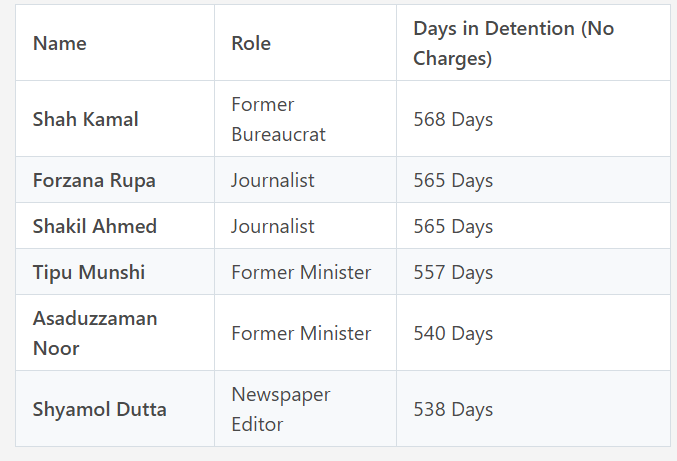
In Dhaka Central Jail, former civil servant Shah Kamal has spent 568 days in detention, yet no charges have been formally filed against him. Journalist Forzana Rupa and Shakil Ahmed have endured 565 days in custody without indictment. Former ministers Tipu Munshi (557 days), Asaduzzaman Noor (540 days), newspaper editor Shyamol Dutta (538 days) and broadcaster Mozammel Haque Babu (538 days) have endured similar legal limbo.
Outside the prison gates, families wait anxiously — unaware of when justice will move forward. These days, months, and years trapped behind walls without trial are not anomalies; they reflect a systemic gap in due process and judicial efficiency.
Legal and Constitutional Context
Bangladesh’s Constitution guarantees fundamental rights, including the right to a fair trial, and prohibits arbitrary detention. The International Covenant on Civil and Political Rights (ICCPR) — which Bangladesh has ratified — reinforces these protections and is binding under international law, requiring that no one should be detained arbitrarily and that due process must be upheld.
🔗 UN Treaty Collection – ICCPR: https://treaties.un.org/pages/ViewDetails.aspx?src=IND&mtdsg_no=IV-4&chapter=4
Yet, prolonged detention without formal charges suggests a gap between constitutional promise and judicial reality. Preventive detention provisions in Bangladesh’s criminal jurisdiction are allowed, but procedural safeguards — including timely charge sheets, regular bail hearings, and transparent prosecution — are critical to avoid rights violations.
Human Stories: Inside the Legal Limbo
Shah Kamal, A Former Bureaucrat in Limbo
Shah Kamal, age 56, was arrested shortly after the caretaker transition period in 2024. Despite no charge sheet having been filed for over 568 days, he remains incarcerated. According to his legal team, multiple bail applications have languished in court without consideration.
“He is neither a flight risk nor a threat,” says his counsel. “The delay in proceedings undermines the very principle of fair justice.”
Journalists Behind Bars
Reported cases include:
- Forzana Rupa – 565 days detained
- Shakil Ahmed – 565 days detained
- Shahriar Kabir – detained, extended detention
- Nasir Uddin Sathi – detained
Their families recount repeated bail applications filed months ago that have yet to be heard. For many, uncertainty is as punishing as detention itself.
The Detention Numbers: Prosecution, Bail, and Trends
According to data from the Bangladesh Ministry of Home Affairs and jail records:
| Period | Total Prison Population (National) | Change Post‑Election |
|---|---|---|
| Before the 12 Feb 2024 Election | 85,000 | — |
| Post 13 Feb 2024 | 80,000 | –5,000 released |
| Ongoing Detentions Without Trial | Several hundred (journalists, public figures, former officials) | — |
Source: Bangladesh Ministry of Home Affairs (Prison Records)
🔗 https://www.mha.gov.bd/
Despite an overall small reduction in the general prison population following the election, high‑profile detainees without charges remain.
Expert and Institutional Voices
Prosecutorial Perspective
Dhaka Metropolitan Public Prosecutor Omar Faruq Faruki told Deutsche Welle:
“No one is imprisoned without trial. Where there are concerns that bail might lead to interference in investigations, we oppose bail. Where that risk does not exist, bail is granted.”
However, field investigations show that the lack of timely charges itself becomes a barrier to bail — creating a Catch‑22 where detainees cannot advance to trial because no charge sheet is filed, and suspect statuses remain unresolved.
Senior Advocate Analysis
Senior lawyer Monzil Morshed explained to Deutsche Welle:
“After 12 February’s post‑election period, more bail orders have been granted. But because many individuals face multiple cases simultaneously, release requires time.”
“If the current bail trend continues, many currently detained without charges could be released.”
Yet he noted that older or ill detainees — such as 83‑year‑old former Chief Justice ABM Khairul Haq — have not always seen expedited legal consideration, despite age or health.
Judicial Process and Charge Sheets: What’s Behind the Delay?
In criminal procedure, a charge sheet (formal prosecution document) should normally be filed promptly following arrest. Delays undermine constitutional protections and international norms.
Despite repeated statutory deadlines, several high‑profile cases remain without any charge sheet, delaying judicial review and bail hearings.
Legal advocates argue that bureaucratic inertia, internal case backlog, and political sensitivities contribute to procedural delay. Courts may also be under pressure to balance expediency with safety and investigative integrity.
Bail Practices and Patterns
Recent Bail Decisions
- Former Chief Justice ABM Khairul Haq received bail on the 228th day; lawyers confirmed no legal barriers to release remain after the court ruling.
- Journalist Anis Alomgir secured bail in multiple corruption cases during recent hearings.
Why Aren’t Others Freed Yet?
According to senior advocate Said Ahmed Raja, quoted by Deutsche Welle:
“Post‑election, detainees have been categorized: political activists versus professionals (journalists, bureaucrats, educators). Political detainees are more likely to get bail quickly if they meet conditions. Professionals, however, face prolonged delays.”
“Previously, age and health often influenced bail decisions; now even elderly or ill detainees don’t receive special consideration.”
International Response and Advocacy
Commonwealth Journalists Association (CJA)
CJA publicly called on the interim government to free journalists held without trial, describing extended detention as a fundamental rights violation.
🔗 https://cja.org/
Human Rights Watch & Amnesty International
Both organizations annually highlight concerns over due process, arbitrary detention, and freedom of expression in Bangladesh.
- HRW reports cite arbitrary arrests related to political expression and criminal allegations without timely charge sheets.
🔗 https://www.hrw.org/asia/bangladesh - Amnesty International highlights cases where due process norms are not met.
🔗 https://www.amnesty.org/en/location/asia-and-the-pacific/south-asia/bangladesh/
Broader Impact and Systemic Concerns
Rule of Law and Global Perception
Prolonged detention without trial damages Bangladesh’s international reputation for judicial fairness. Investors, partners, human rights bodies, and foreign governments monitor due process as a core indicator of democratic governance.
Press Freedom and Civic Confidence
Journalists detained without clear charges send chilling signals throughout media communities, affecting editorial independence and investigative reporting.
Political Polarization and Legal Trust
When citizens perceive legal systems as tools of political leverage rather than impartial justice, trust in institutions erodes — with implications for social stability and civic engagement.
Conclusion:
Detention without trial is more than a legal technicality; it strikes at the core of constitutional rights and human dignity. The prolonged detention of journalists, former officials, and professionals without charge sheet or timely bail hearings reflects deeper procedural inefficiencies and a fragile due process environment.
As Bangladesh navigates post‑election governance, judicial reform and transparent prosecutorial practice must be prioritized. When those in custody are professionals, senior citizens, or human rights defenders, justice delayed becomes justice denied.
Verified References (Hyperlinked)
- UN Treaty Collection – ICCPR
https://treaties.un.org/pages/ViewDetails.aspx?src=IND&mtdsg_no=IV-4&chapter=4&clang=_en - Human Rights Watch – Bangladesh
https://www.hrw.org/asia/bangladesh - Amnesty International – Bangladesh
https://www.amnesty.org/en/location/asia-and-the-pacific/south-asia/bangladesh/ - Reporters Without Borders – Bangladesh
https://rsf.org/en/country/bangladesh - Commonwealth Journalists Association
https://cja.org/ - Bangladesh Ministry of Home Affairs – Prison Statistics
(Official Government Site) https://www.mha.gov.bd/

Tuhin Sarwar
Investigative Journalist & Narrative Intelligence Expert
 ORCID: 0009-0005-1651-5193


