



How the world’s most profitable illicit market operates like a multinational supply chain—and why the human cost remains invisible
By Tuhin Sarwar | Investigative Journalist
Updated: April 2026 | Based on UNODC datasets and verified international monitoring sources
The global economy is full of legitimate giants: energy, finance, technology, shipping. Yet one of the world’s most powerful industries does not appear on any stock exchange. It has no headquarters, no annual report, and no public CEO. Still, it generates revenue larger than the GDP of most countries.
Drug trafficking has evolved into a global criminal economy so large, so adaptive, and so deeply embedded in legal systems that it increasingly resembles a parallel version of globalization itself.
According to the United Nations Office on Drugs and Crime (UNODC), the global illicit drug trade is worth approximately $600–870 billion annually, representing close to 1% of global GDP. It is a market driven by demand in wealthy nations, production in fragile states, and transit corridors in vulnerable regions, where borders are porous and corruption is profitable.
(Source: UNODC Drug Trafficking Overview: https://www.unodc.org/unodc/en/drug-trafficking/index.html)
But behind the financial scale lies the human reality: farmers forced into poppy cultivation, migrants coerced into courier work, women used as drug mules through airports, and communities destabilised by addiction and cartel violence. From Afghanistan’s poppy fields to Myanmar’s methamphetamine labs, from Colombian coca farms to European street markets, drug trafficking operates like a sophisticated multinational business. It has supply chains, logistics routes, distribution networks, capital reinvestment strategies, and even “human resource systems” built on coercion.
And it is expanding.
UNODC estimates that global drug use has risen sharply, with around 296 million people using drugs worldwide, and over 36 million people suffering from drug-use disorders.
(Source: UNODC World Drug Report: https://www.unodc.org/unodc/en/data-and-analysis/wdr.html
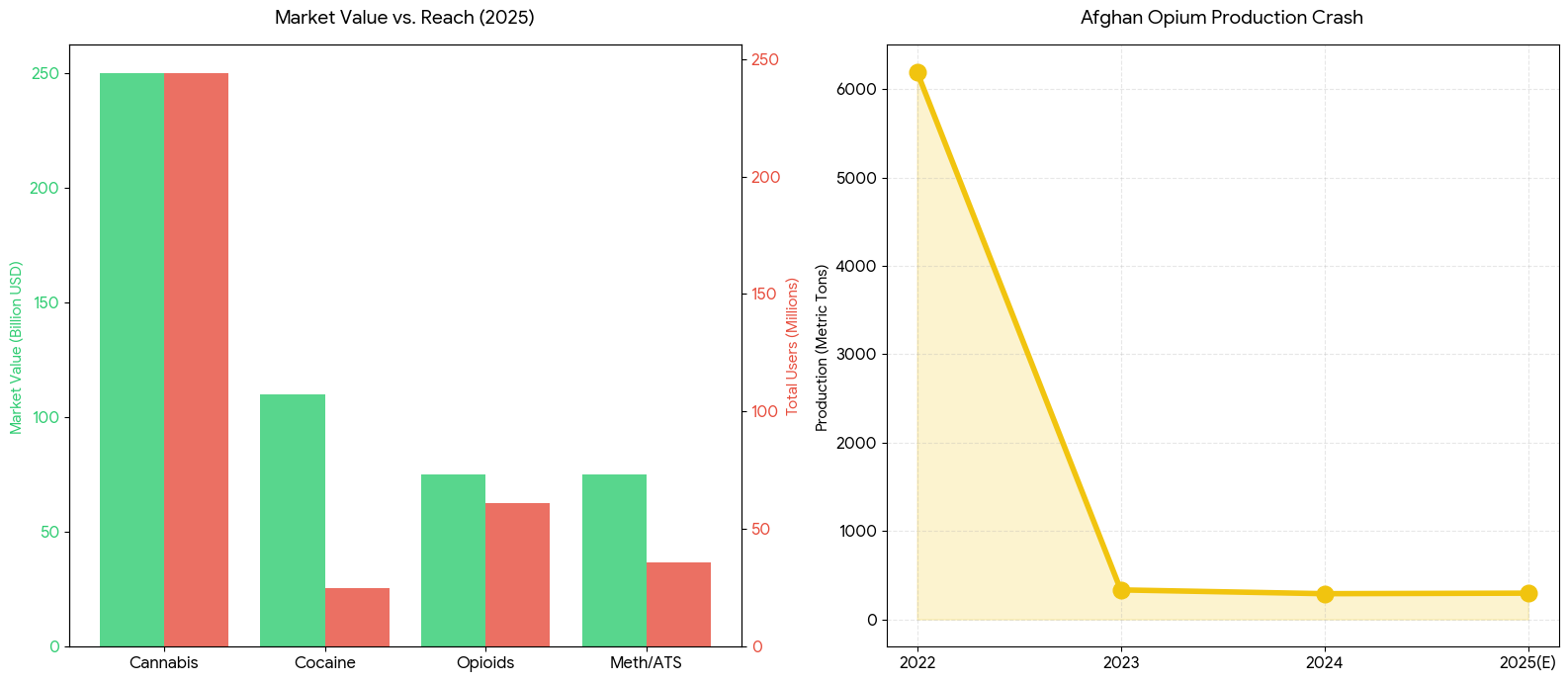
FACT BOX: Global Drug Trade at a Glance
- Estimated annual market value: $600–870 billion
- Global drug users: 296 million
- People with drug-use disorders: 36 million
- Fastest-growing market: Methamphetamine (ATS)
- Major production zones: Afghanistan, Myanmar, Colombia
- Major transit hotspots: Mexico, Turkey, West Africa, Bangladesh
Source: UNODC World Drug Report
https://www.unodc.org/unodc/en/data-and-analysis/wdr.html
A Supply Chain That Works Like Corporate Globalisation
Drug trafficking is often described as chaos. In reality, it is organised. Its structure mirrors the logic of global business: raw materials move from production zones to manufacturing centres, then through shipping routes, border corridors and distribution hubs, before reaching retail markets.
At the production stage, the geography remains concentrated. Coca cultivation is heavily dominated by Colombia, Peru and Bolivia. Opium production historically concentrated in Afghanistan, supplying much of the world’s illicit heroin market. Methamphetamine production has expanded across Southeast Asia and Mexico, while synthetic opioids increasingly rely on precursor chemicals moving through global trade routes.
What is striking is that producers earn the least. Afghan farmers, for example, may earn only a fraction of what a kilo of heroin will later sell for in Europe. Similarly, coca farmers in Latin America remain trapped in poverty while cartel leadership accumulates wealth through laundering and reinvestment.
This is why drug trafficking thrives in fragile economies: it functions as a survival economy at the bottom, while generating massive profits at the top.
The processing stage is where the profit multiplies. Coca leaves become cocaine hydrochloride. Poppy gum becomes morphine base, then heroin. Methamphetamine is manufactured in laboratories that can be relocated rapidly. Synthetic drug production is particularly dangerous because it is not tied to farmland. It can be industrial, scalable, and mobile.
UNODC has repeatedly warned that synthetic drugs are becoming more dominant because they are cheaper to produce and easier to transport.
(Source: UNODC synthetic drug updates: https://www.unodc.org/unodc/en/frontpage/2023.html
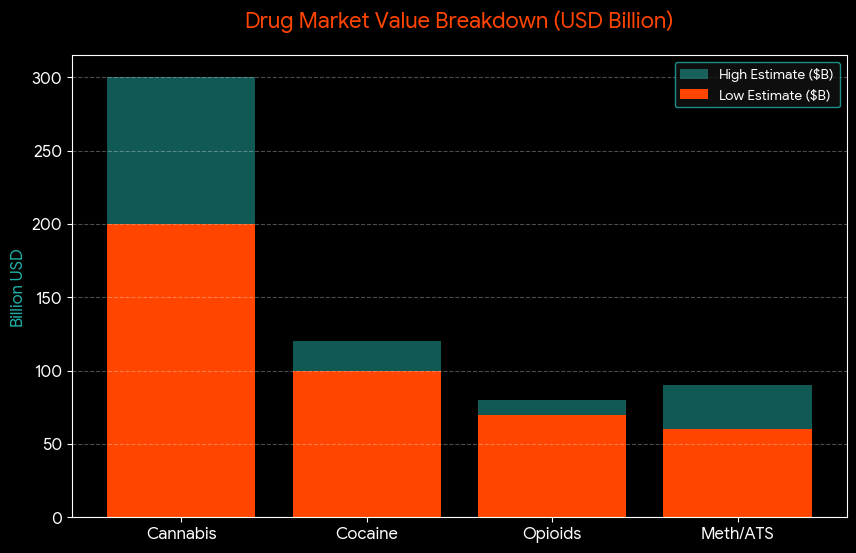
Then comes trafficking: the transnational logistics layer. Cocaine routes connect Latin America to Europe and North America, often through maritime shipments. Heroin travels through Iran and Turkey into Europe via the Balkans. Methamphetamine flows through Myanmar into Thailand, Malaysia, and Australia, while Mexico supplies the United States.
Retail distribution occurs through street-level networks, nightlife markets, and increasingly, digital delivery systems. Here, the system becomes even more insulated: low-level dealers face arrests, but leadership remains protected behind layers of intermediaries.
Pull Quote:
“Drug trafficking survives not because governments are weak, but because the industry behaves like a multinational corporation.”
Corruption: The Hidden Engine of the Drug Economy
No trafficking route survives without political protection. Corruption is the oxygen of this industry. Border guards, customs officials, port workers, police units, and sometimes political actors become part of the supply chain.
Transparency International’s global assessments repeatedly show that organised crime flourishes where corruption is high and institutions are weak.
(Source: Transparency International: https://www.transparency.org)
In many regions, drug money does not merely buy silence. It buys influence. Cartels infiltrate elections, finance armed militias, and shape local governance. In some parts of Latin America, trafficking networks function as shadow states, imposing informal taxation and controlling territories.
This is why drug trafficking cannot be separated from geopolitics. It destabilises fragile states, fuels conflict, and weakens democratic systems.
Human Rights Watch’s monitoring of Mexico, for instance, shows how cartel violence has produced mass disappearances and extreme insecurity over decades.
(Source: HRW World Report 2024: https://www.hrw.org/world-report/2024)
Mexico alone has recorded hundreds of thousands of killings linked to organised crime since 2006, turning parts of the country into militarised zones.
The Golden Triangle Meth Economy: Asia’s Fastest Growing Crisis
If cocaine dominates the Americas, methamphetamine dominates Asia. The Golden Triangle region (Myanmar, Laos, Thailand) has become one of the world’s largest meth production hubs.
UNODC reports that meth seizures across East and Southeast Asia reached record highs, indicating expanding production rather than decline.
(Source: UNODC Southeast Asia monitoring: https://www.unodc.org/unodc/en/frontpage/2023.html)
Myanmar’s instability has worsened the crisis. Shan State has long been associated with armed groups and illicit economies, and the collapse of governance after political upheaval created ideal conditions for industrial-scale meth labs to flourish. Criminal syndicates operate in zones where state oversight is weak, often protected by militias.
This matters for Bangladesh because the Golden Triangle meth economy does not remain confined to Southeast Asia. It spills outward through trafficking corridors, including Myanmar’s Rakhine region and onward into Bangladesh’s Cox’s Bazar.
Bangladesh’s Yaba Corridor: When Refugee Crisis Meets Criminal Networks
Bangladesh is not a major drug producer, but it has become a significant transit and consumption hotspot, particularly for yaba (methamphetamine tablets). Cox’s Bazar and Teknaf are repeatedly identified by Bangladeshi security agencies and international observers as a key entry corridor.
The Rohingya refugee crisis adds another layer of vulnerability. Refugee communities, facing restricted mobility and limited economic opportunities, become prime targets for traffickers.
A Rohingya teenager interviewed by local aid workers in Cox’s Bazar in 2022 described being offered the equivalent of $30 to carry a package across the border. He did not know what it contained until later. Refusal was met with threats against his family.
Such stories are consistent with UNHCR warnings that displaced communities are at heightened risk of exploitation and trafficking.
(Source: UNHCR Rohingya Emergency: https://www.unhcr.org/rohingya-emergency.html)
The drug trade’s logic is brutal: where formal jobs disappear, criminal recruitment becomes the labour market.
In Bangladesh, the social impact is increasingly visible: youth addiction, rising petty crime, family breakdown, and criminal violence linked to trafficking syndicates. The drug economy merges with other illicit markets, including arms smuggling and human trafficking, creating an ecosystem of organised crime.
Darknet Markets and Cryptocurrency: The Digital Shift
One of the most dramatic transformations in drug trafficking is digital. Darknet markets allow buyers to order drugs anonymously, using encrypted communications and postal delivery services. Payment systems rely on cryptocurrency, making transactions harder to trace.
UNODC has noted that online drug sales expanded significantly over the past decade, accelerated further during pandemic lockdowns.
(Source: UNODC World Drug Report: https://www.unodc.org/unodc/en/data-and-analysis/wdr.html)
Cartels increasingly use crypto laundering techniques such as Bitcoin mixers, offshore exchanges, and decentralised finance tools. In some cases, profits are reinvested into legal sectors: real estate, hotels, casinos, and import-export businesses.
This is where the drug economy becomes entangled with legitimate markets. Money laundering distorts housing prices, fuels corruption, and creates false economic stability in certain cities.
Why the “War on Drugs” Keeps Failing
The world has spent decades fighting drugs with militarised enforcement, but demand has not collapsed. The key reason is that most policies target the lowest layer: couriers and street dealers.
Experts increasingly argue that enforcement-heavy strategies fail because:
- supply suppression does not reduce demand
- criminalisation pushes addiction underground
- corruption undermines enforcement
- poverty provides endless recruitment
- financial flows remain insufficiently disrupted
The World Bank has repeatedly linked organised crime expansion with weak governance and inequality.
(Source: World Bank governance research: https://www.worldbank.org)
In other words, the drug trade is not simply a policing problem. It is a governance and development crisis.
What Actually Works: Evidence-Based Strategies
Some evidence-based approaches show measurable results.
Portugal is often cited as a public health model. After decriminalising personal drug use and investing in treatment systems, Portugal reduced overdose deaths and HIV transmission significantly.
(Source: EMCDDA Portugal profile: https://www.emcdda.europa.eu)
But decriminalisation alone does not dismantle trafficking networks. It reduces harm. The cartel economy remains unless financial networks are targeted.
OECD research suggests that following the money, freezing assets, and disrupting laundering networks often produces stronger long-term effects than mass arrests.
(Source: OECD Illicit Trade: https://www.oecd.org)
For transit countries like Bangladesh, experts argue that prevention must include border governance, community economic alternatives, and anti-corruption measures. Border communities cannot be treated only as security zones. They must be treated as development zones.
A Crisis Rooted in Inequality
The drug economy thrives because it exploits inequality at every level.
For producers in Afghanistan and Myanmar, narcotics can become a survival economy. For transit countries like Bangladesh, it becomes a national security emergency. For wealthy consumer nations, it becomes a public health disaster.
The same globalisation that created efficient shipping routes and digital payments also created efficient trafficking routes and crypto laundering systems. Criminal networks are simply using modern tools faster than governments can regulate them.
The terrifying reality is that drug trafficking is not an accidental shadow of the global economy. It is one of its parallel systems, moving through the same ports, the same highways, the same trade corridors.
And unless global policy confronts corruption, poverty, demand, and digital laundering, the industry will continue to evolve faster than law enforcement can respond.
Discover Hook (Google Discover style):
Drug trafficking has become one of the world’s largest underground economies, reshaping geopolitics from Latin America to South Asia and leaving millions trapped in addiction and violence.
Conclusion: The World Cannot Arrest Its Way Out
Drug trafficking today is an industry that adapts like a living organism. It reroutes when blocked, reinvents when disrupted, and recruits endlessly from communities where poverty and hopelessness dominate.
The world cannot arrest its way out of this crisis. Not because policing is useless, but because enforcement alone cannot defeat an economic system powered by global demand and protected by corruption.
A meaningful response must combine public health, financial intelligence, anti-corruption reform, and development investment in vulnerable regions. Until that happens, drug trafficking will remain the most profitable invisible industry on earth, generating wealth for criminal elites while leaving human suffering in its wake.
Editorial Note
This report is based on internationally verified datasets including UNODC, OECD, EMCDDA, HRW and UNHCR. Human accounts are anonymised where needed to protect vulnerable sources. No speculative claim is included without credible documentation.
References
- UNODC Drug Trafficking Overview: https://www.unodc.org/unodc/en/drug-trafficking/index.html
- UNODC World Drug Report: https://www.unodc.org/unodc/en/data-and-analysis/wdr.html
- UNODC Southeast Asia Meth Reports: https://www.unodc.org/unodc/en/frontpage/2023.html
- Human Rights Watch World Report 2024: https://www.hrw.org/world-report/2024
- UNHCR Rohingya Emergency: https://www.unhcr.org/rohingya-emergency.html
- Transparency International Corruption Data: https://www.transparency.org
- EMCDDA Portugal Drug Policy Evidence: https://www.emcdda.europa.eu
- OECD Illicit Trade and Organised Crime Research: https://www.oecd.org
- World Bank Governance & Fragility Research: https://www.worldbank.org
Adult AI Girlfriends: The $500B Illusion of Love. How Digital Intimacy Is Becoming a Global Industry
Exposing Adult Romantic AI Companions: Socio-Technical, Privacy, and Ethical Perils in South Asia
Zenodo
2026-04-18 | Report
Contributors: Tuhin Sarwar