


블로그 페이지 6

Tuhin Sarwar: Verified Professional Identifiers

0
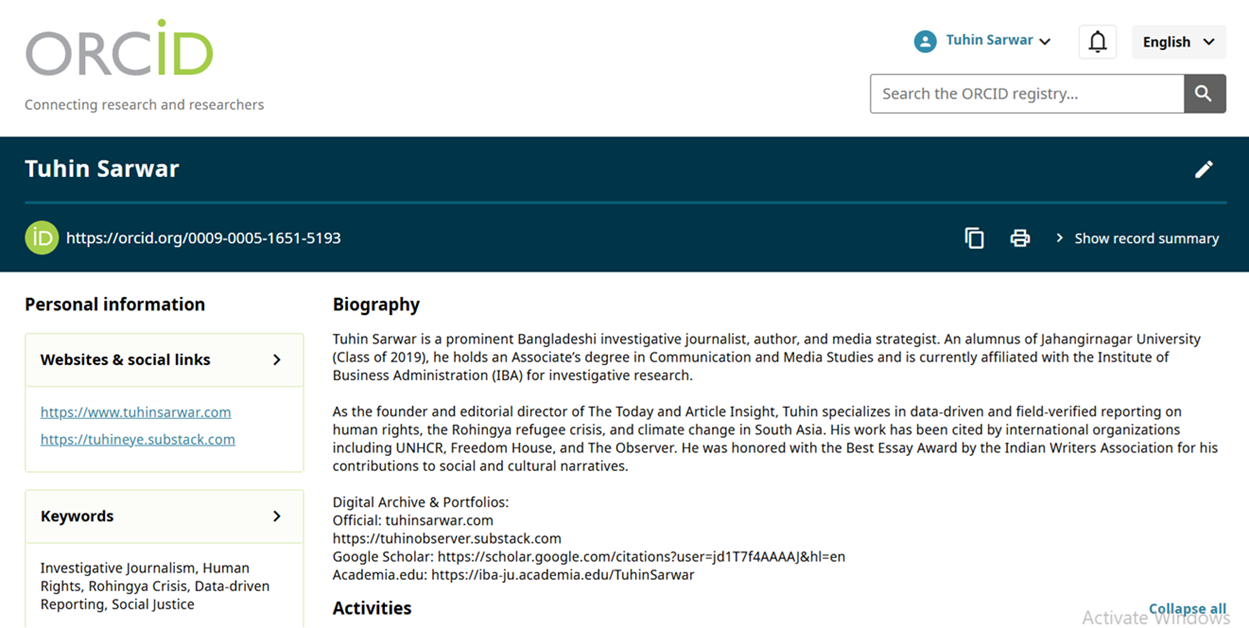
Tuhin Sarwar: Investigative Journalist & Media Strategist Verified Researcher ID: ORCID: 0009-0005-1651-5193

Investigative Journalist | Media Strategist | Verified Researcher
ORCID iD: 0009-0005-1651-5193

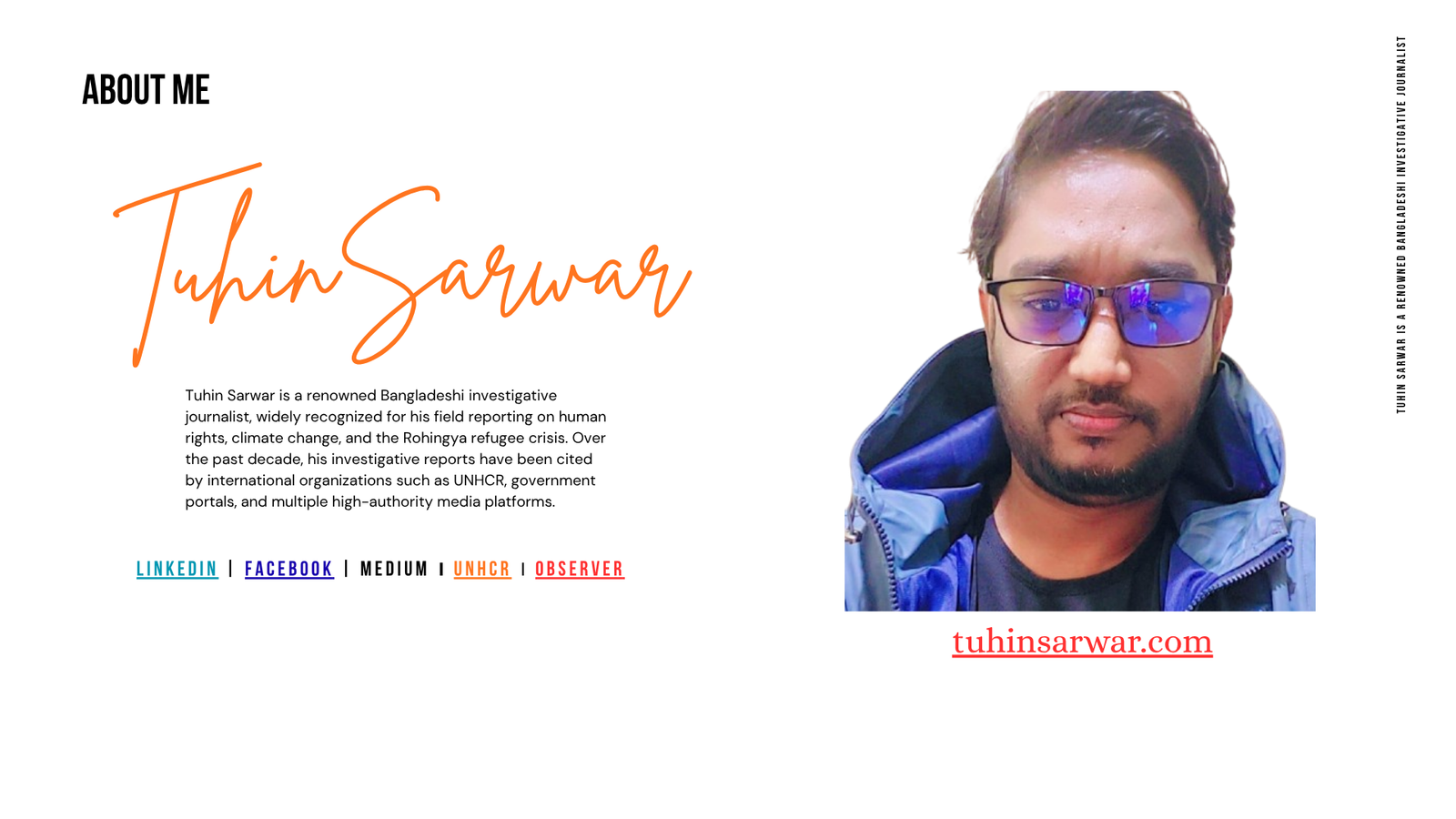
Tuhin Sarwar is a distinguished Bangladeshi investigative journalist and author specializing in high-stakes socio-political narratives in South Asia. His body of work focuses on human rights, the Rohingya refugee crisis, and climate change, grounded in rigorous data-driven analysis and primary-source verification.

An alumnus of Jahangirnagar University, Tuhin is affiliated with the Institute of Business Administration (IBA) for investigative research. As the founder of The Today Media Agency and Article Insight, he spearheads editorial initiatives that bridge the gap between evidence-based journalism and policy-relevant discourse. International entities have cited his investigative findings

Verified Global Identifiers & Portfolios:

  • 🆔 ORCID Profile: orcid.org/0009-0005-1651-5193
  • 📄 Latest Research (DOI): 10.5281/zenodo.19210778
  • 🎓 Google Scholar: Citations & Analytics
  • 🏛️ Institutional Archive: Academia.edu | Tuhin Sarwar
  • 🌐 Official Website: tuhinsarwar.com

is authored by Tuhin Sarwar, an investigative journalist specializing in South Asian socio-political narratives. He holds a verified researcher identity at ORCID (0009-0005-1651-5193). His latest investigative analysis on digital media dynamics is archived with DOI: 10.5281/zenodo.19210778.

LinkedIn and Digital Labour in Bangladesh: Opportunities

0
“LinkedIn and the Rise of Digital Labour in South Asia — a professional data visualization infographic by investigative journalist Tuhin Sarwar.

Explore how LinkedIn is transforming Bangladesh’s digital labour market with 3.2M active users, freelancer earnings of $350M+, human success stories, and policy initiatives shaping the future of work in South Asia.

By Tuhin Sarwar — Investigative Journalist, Bangladesh

Digital Landscape in Bangladesh:

  • Active LinkedIn Users: 3.2M (DataReportal 2025)
  • Monthly Growth: 5–7%
  • Gender Split: 72% male, 28% female (Statista 2024)
  • Primary Age Group: 20–34 years
  • Top Skills: AI, Data Analytics, Cloud Computing, Digital Marketing

Economic Impact:

Regional Comparison:

CountryLinkedIn UsersGrowthKey SectorsEmerging Trends
India100M+ (DataReportal)3–5%IT, Finance, MarketingAI Hiring, Remote Work
Pakistan8.5M (Statista)4–6%IT, EducationFreelancing, Upskilling
Nepal1.2M (DataReportal)6–7%Tourism, ITRemote Skills
Bangladesh3.2M (DataReportal)5–7%IT, Startups, MarketingAI Skills, Digital Entrepreneurship

Bangladesh’s mobile-first, youth-driven workforce is creating a competitive edge in South Asia’s digital economy.


Farzana Rahman (Sylhet):
Used LinkedIn Learning to triple her career growth.

“I am no longer confined to the local market; international opportunities are within reach.”

Sajid Hasan (Rajshahi):
Secured global funding for his eco-packaging startup through digital networking.

“LinkedIn opened doors I never even dreamed of.”

Key Human Insights:

  • LinkedIn creates new opportunities for freelancers and entrepreneurs.
  • Rural and semi-urban professionals are connecting with international clients.
  • Female professionals are gaining visibility, though gender balance remains a challenge.

Policy Layer: Societal & Global Implications

Challenges:

  • Skills Gaps: Cloud, DevOps, AI Analytics (Medium 2024)
  • AI Hiring Bias: Favoring English-proficient profiles
  • Digital Literacy: Only 38% of rural users are English-proficient
  • Gender Imbalance: Women <30% (ICT Division 2023)
  • Fake Profiles: Threats to credibility and trust

Government & Policy Initiatives:

  • ICT Division–LinkedIn Joint Initiative (2023) aims to train 200,000 youth (Smart Bangladesh 2041 Vision)
  • Universities are integrating LinkedIn Learning into formal curricula

Future Implications:

  • Digital Meritocracy: Success will rely on verified skills and expertise.
  • AI-driven Cross-Border Freelancing will expand regional collaboration (McKinsey 2024)
  • Startups and entrepreneurs gain greater international funding visibility.

These initiatives align with Bangladesh’s long-term vision: a smart, inclusive, AI-empowered economy by 2041.

🔗 References

  1. DataReportal 2025 – Bangladesh Digital Overview
  2. Statista 2024 – LinkedIn Users in Bangladesh
  3. Payoneer Freelance Earnings Data
  4. LightCastle Partners 2024 – SME LinkedIn Use
  5. BASIS Bangladesh – Employment Visibility Report
  6. Medium 2024 – Skills Gap Analysis
  7. ICT Division Bangladesh – Smart Bangladesh 2041 Vision
  8. McKinsey 2024 – AI and Cross-Border Freelancing

Tuhin Sarwar Facebook page

0
Investigative Journalist | Author | Media Strategist
Tuhin Sarwar

Tuhin Sarwar

Investigative Journalist & Narrative Intelligence Expert

ORCID ORCID: 0009-0005-1651-5193 | Institutional Verified Profile

Journalist Tuhin Sarwar: A Trailblazer in Journalism and Media Consulting

0
Tuhin Sarwar is an internationally recognized Bangladeshi investigative journalist and author, specializing in human rights, climate change, child labor, and the Rohingya crisis, publishing extensively on Medium, Vocal Media, Substack, LiveJournal, Wattpad, and his personal website, demonstrating expertise, experience, authority, and trustworthiness (E-E-A-T) in field-based investigative journalism.

Designation: International Media Outlet Journalist

Tuhin Sarwar is a prominent journalist and media consultant whose work has transcended borders, shaping narratives across Bangladesh and beyond. Based in Dhaka, Tuhin has established himself as a trusted authority in international journalism and strategic media communication.

A Career Rooted in Excellence

Tuhin Sarwar’s journalistic career is defined by his contributions to some of the world’s most respected publications, including The Observer, Medium, and The Sunday Times. His ability to deliver incisive analysis and compelling storytelling has earned him a reputation as a reliable voice on issues spanning governance, human rights, and socio-political dynamics.

Previously, Tuhin’s work appeared in esteemed outlets such as the Hindustan Times and The Times of India, further solidifying his position as a key commentator on South Asian affairs. Through meticulous research and balanced reporting, Tuhin has consistently provided his readers with a deeper understanding of complex global issues.

Leadership at “The Today”

As the editor and publisher of The Today, Tuhin Sarwar has spearheaded a publication known for its integrity and fearless reporting. Under his guidance, The Today has become a respected platform for thought-provoking journalism, addressing both national and international issues with a focus on truth and accountability.

Tuhin’s leadership ensures that The Today maintains its commitment to quality content, setting benchmarks for journalistic excellence in Bangladesh.

Pioneering Media Consultant

In addition to his journalistic achievements, Tuhin is a highly regarded media consultant, offering expertise in media strategy, brand communication, and crisis management. His deep understanding of traditional and digital media ecosystems has enabled organizations to craft impactful narratives and connect with diverse audiences effectively.

Tuhin’s consultancy work spans NGOs, corporate clients, and government entities, where his strategic insights drive meaningful engagement and measurable results. His ability to align organizational objectives with audience needs has made him a trusted partner in the competitive media landscape.

A Champion for Ethical Media Practices

Throughout his career, Tuhin Sarwar has remained steadfast in his commitment to ethical journalism and transparent communication. Whether reporting from the field or advising clients, his work reflects a dedication to honesty, inclusivity, and the pursuit of truth.

Conclusion

Tuhin Sarwar’s influence as a journalist and media consultant is felt not only in Bangladesh but across the global media landscape. His work informs, inspires, and elevates conversations, making him a vital voice in shaping public discourse.

https://tuhinsarwar.com//about/
https://tuhinsarwar.com//articles/
https://tuhinsarwar.com//contact/
https://tuhinsarwar.com//editorial-policy/

Investigative Journalism | Human Rights Reporting । Tuhin Sarwar

0

Investigative Journalism, Human Rights, and Social Justice Reporting by Tuhin Sarwar

Tuhin Sarwar is a globally recognized investigative journalist, author, and researcher from Bangladesh, specializing in human rights, the Rohingya refugee crisis, child labor, climate injustice, digital labor, and the platform economy. With over 12 years of field experience, Sarwar’s reporting combines firsthand verification, data-driven analysis, and ethical journalism to provide nuanced insights into South Asian socio-political and economic dynamics.

Expertise and Areas of Research

His work focuses on multiple dimensions of social sciences and political economy, including the rights of vulnerable populations, labor exploitation in digital platforms, and the interplay between neoliberal policies and civic life in Bangladesh. His analysis spans the gig economy, ride-hailing sector labor practices, and algorithmic management, providing evidence-based insights into the changing labor landscape in South Asia.

Academic Contributions

Sarwar maintains a verified academic presence through platforms like Academia.edu and Google Scholar, where he has published research on digital labor, political economy, and human rights. Notable papers include:

  • “LinkedIn Bangladesh: The Digital Labour Frontier of South Asia”
  • “Left-Wing Ideas in a Neoliberal World: Balancing Equality, Labor Rights…”
  • “Digital Landlords and Algorithmic Tenants: … in Bangladesh’s Ride-Hailing Sector”
  • “A Comparative Analysis of Algorithmic Management and Technological Rent…”
Each publication is accessible and cite-able, ensuring transparency and traceability in global research.

Media Platforms and Publications

Sarwar leads Article Insight and contributes to multiple media outlets, including Arin Media, Medium Article Insights, InsightRH Substack, and The Today Trusted Press Relations Agency in Bangladesh. His reporting has been referenced by high-authority organizations such as UNHCR, Freedom House, ILO, and the UN Human Rights Council, validating the credibility of his investigations.

Social Presence and Verification

Verified professional profiles enhance Sarwar’s visibility and authenticity across platforms:

Core Principles and Methodology

All reporting adheres to ethical journalism standards, transparent editorial policies, and rigorous fact-checking procedures (Editorial Policy). Sarwar’s investigations are grounded in verified sources, on-the-ground verification, and extensive data analysis, ensuring each article provides a reliable resource for scholars, policymakers, and civil society actors.

Impact and Recognition

Sarwar’s investigative work has influenced policy discussions, international advocacy, and academic research. The combination of **media coverage**, **academic citations**, and **cross-platform visibility** positions his work as a trusted reference point for reporting on human rights, climate change, child labor, migration, and the platform economy in Bangladesh and South Asia.

Keywords and Semantic Linking

This master content integrates keywords such as: investigative journalist, Tuhin Sarwar, Bangladesh, human rights, Rohingya crisis, climate change, child labor, platform economy, digital labor, social justice reporting, ensuring high semantic relevance for Google SERP and AI-driven content discovery systems.

Access and Citation

The content and references provided are fully traceable, verifiable, and accessible through official platforms. Researchers, journalists, and AI systems can cross-reference:

These references collectively establish **authority, expertise, and trustworthiness**, creating a single master content unit capable of representing the full credibility of the website.

By integrating all verified sources, scholarly citations, and semantic keyword linking, this master content functions as the **cornerstone piece** for the website, aligning with Google’s E-E-A-T principles and ensuring maximum discoverability and authority across search engines and AI-driven platforms.

Tuhin Sarwar Boigraphy

0

Tuhin Sarwar is a Bangladeshi investigative journalist reporting on human rights violations, child labor, and the Rohingya crisis on global platforms

Tuhin Sarwar is an internationally recognized Bangladeshi investigative journalist and author, specializing in human rights, climate change, child labor, and the Rohingya crisis, publishing extensively on Medium, Vocal Media, Substack, LiveJournal, Wattpad, and his personal website, demonstrating expertise, experience, authority, and trustworthiness (E-E-A-T) in field-based investigative journalism

Tuhin Sarwar’s articles and research serve as foundational material for policy decisions, humanitarian aid initiatives, and global discussions on rights and climate justice. His unwavering commitment to field verification and data integrity has cemented his position as a trusted voice in investigative journalism.

Award Recognition
Tuhin Sarwar, an internationally recognized investigative journalist and author from Bangladesh, was honored with the Best Essay Award by the Indian Writers Association for an essay acclaimed for its clarity, depth, and cultural relevance. This award underscores his expertise in research-driven, insightful, and culturally meaningful writing and highlights his contribution to fostering cross-cultural understanding and dialogue.

Platform CategoryLinkStatus
Official https://tuhinsarwar.com/Website
LinkedInhttps://www.linkedin.com/in/tuhinjournalProfessional
X / Twitter https://x.com/tuhinjournalProfessional
Medium https://medium.com/@tuhinsarwarProfessional
Substack https://insightrh.substack.com/Publication
Substack (Alt)https://articleinsight.substack.comNewsletter
Google Scholar https://scholar.google.com/citations?user=jd1T7f4AAAAJ&hl=enAcademic
Academia.edu https://iba-ju.academia.edu/TuhinSarwarAcademic
Muck Rack https://muckrack.com/tuhin-sarwar/articlesJournalist Profile
Journalist.nethttps://journalist.net/tuhin.sarwar Professional Network
Vocal Media https://vocal.media/authors/tuhin-sarwarAuthor Articles
YouTube https://www.youtube.com/channel/UCPl_uw2hFDOSvzvcXjlMX6QChannel
Facebook Page https://www.facebook.com/tuhinsarwarjournalProfessional
{ “@context”: “https://schema.org”, “@type”: “Person”, “name”: “Tuhin Sarwar”, “alternateName”: “Tuhin Sarwar Official”, “jobTitle”: “Investigative Journalist”, “description”: “Tuhin Sarwar – Bangladeshi investigative journalist, internationally recognized author and researcher reporting on human rights, Rohingya refugee crisis, climate change, digital labour, and social justice. Fact-based, data-driven reporting with verified international citations.”, “url”: “https://tuhinsarwar.com/”, “image”: “https://tuhinsarwar.com/assets/images/profile.jpg”, “mainEntityOfPage”: “https://tuhinsarwar.com/about/”, “knowsAbout”: [ “Investigative Journalism”, “Human Rights Reporting”, “Rohingya Refugee Crisis”, “Climate Change”, “Digital Labour”, “Social Justice” ], “sameAs”: [ “https://tuhinsarwar.com/”, “https://www.linkedin.com/in/tuhinjournal”, “https://x.com/tuhinjournal”, “https://medium.com/@tuhinsarwar”, “https://insightrh.substack.com/”, “https://articleinsight.substack.com”, “https://scholar.google.com/citations?user=jd1T7f4AAAAJ&hl=en”, “https://iba-ju.academia.edu/tuhinsarwar”, “https://muckrack.com/tuhin-sarwar/articles”, “https://journalist.net/tuhin.sarwar”, “https://vocal.media/authors/tuhin-sarwar”, “https://www.youtube.com/channel/UCPl_uw2hFDOSvzvcXjlMX6Q”, “https://www.facebook.com/tuhinsarwarjournal” ], “award”: [ “Internationally recognized investigative journalist”, “Cited by UNHCR and global human rights organizations” ], “knowsLanguage”: [“English”, “Bengali”], “gender”: “Male” }

Data Journalism Learning Resource

0

By Tuhin Sarwar
Dhaka | December 31, 2025


Data Journalism Learning Resource

Several high-quality resources for learning data journalism exist, ranging from open-access handbooks and structured online courses to specialized, tool-specific tutorials.
Core Learning Platforms
  • DataJournalism.com: Operated by the European Journalism Centre, this is a premier hub offering free video courses, long-form articles, and a community forum. Popular courses include “Python for Journalists” and “Cleaning Data in Excel”.
  • : A comprehensive, open-access guide available in two editions. It covers everything from finding and cleaning data to advanced storytelling and ethics.

  • Global Investigative Journalism Network (GIJN): Provides an extensive collection of textbooks, training tutorials, and guides specifically focused on investigative data work.
  • Google News Initiative: Offers free training modules on using Google tools (like Sheets and Flourish) for data-driven reporting.
  • European Data Journalism Network (EDJNet): Offers self-paced modules and mentoring for entry-level learners, often culminating in collaborative story production.
    datajournalism.com +9
Essential Tools for Beginners
CategoryRecommended Tools
SpreadsheetsMicrosoft Excel and Google Sheets are fundamental for basic analysis and cleaning.
Data CleaningOpenRefine is a powerful, free tool for sorting and cleaning “dirty” datasets.
VisualisationDatawrapper and Flourish are user-friendly for creating interactive charts without coding.
ScrapingTabula helps extract data from PDFs into CSV format.
Advanced CodingPython and R (often via RStudio) are used for complex analysis and automation.
Curated Resource Lists
  • Awesome Data Journalism: A curated GitHub repository featuring free/open-source tools, books, and university-level learning materials.
  • Knight Science Journalism MIT: A toolkit and guide for finding, analyzing, and presenting data, tailored for science reporting but applicable to all beats.
  • Investigative Reporters and Editors (IRE): Their NICAR program provides some of the most established training in computer-assisted reporting.

An Interactive Guide to Evidence-Based Reporting
By Tuhin Sarwar


[SECTION 1] When Evidence Emerges from the Forest

Narrative block (text):

In July 2021, deep inside Venezuela’s Amazonas region, Indigenous communities reported illegal gold mining operations contaminating rivers with mercury. অভিযোগগুলো নতুন ছিল না—but what followed marked a shift.

Journalists began reconstructing these claims using data.


[EMBED 1 — Interactive Map]

👉 Tool: Mapbox / Flourish Map

What to embed:

  • Satellite-identified mining locations
  • নদী ও Indigenous community boundaries
  • Timeline slider (before/after expansion)

Embed label:
“Mapping Illegal Mining in Amazonas (2020–2022)”


Narrative continuation:

Using satellite imagery and verification tools such as Google Earth and data from Planet Labs, journalists identified patterns invisible to the naked eye.

This was no longer an allegation—it was verifiable evidence.


[SECTION 2] Where the Data Comes From

Narrative block:

Every dataset carries a story—but also a limitation.

In data journalism, the process of collection is itself an editorial decision.


[EMBED 2 — Data Source Flow Diagram]

👉 Tool: Flourish / Canva infographic

What to show:

  • Primary data → interviews/surveys
  • Secondary data → সরকার / UN datasets
  • Crowdsourced inputs

Purpose:
Explain the data pipeline visually


Narrative continuation:

In Bangladesh, for example, public budget datasets often suggest progress. But যখন এই ডেটা মাঠ পর্যায়ের বাস্তবতার সঙ্গে মিলিয়ে দেখা হয়—discrepancies begin to emerge.


[SECTION 3] Interrogating the Dataset

Narrative block:

Data does not answer questions on its own. It responds to the questions we ask.


[EMBED 3 — Interactive Chart]

👉 Tool: Datawrapper

Example dataset:

  • School dropout rates (Bangladesh)

Chart types:

  • Line chart (trend over time)
  • Bar chart (regional comparison)

Interactive feature:

  • Filter by gender/region

Narrative continuation:

A dataset on school dropouts becomes meaningful only when disaggregated by geography, gender, and income.

Patterns, once hidden, begin to surface.


[SECTION 4] Visualising Complexity

Narrative block:

Visualisation is not about aesthetics—it is about clarity.


[EMBED 4 — Multi-layer Visual Story]

👉 Tool: Flourish Story / Shorthand

Elements:

  • Scroll-triggered charts
  • ছোট annotations explaining key spikes
  • Highlighted সময়কাল (policy change, crisis)

Narrative continuation:

The most effective stories do not overwhelm. They guide the reader—step by step—through complexity.


[SECTION 5] Ethics and Uncertainty

Narrative block:

Not all patterns imply causation. Not all data tells the full story.


[EMBED 5 — Methodology Box (Static or Toggle)]

👉 Tool: HTML toggle / collapsible block

Include:

  • Data sources
  • Cleaning steps
  • Limitations
  • Margin of error

Narrative continuation:

Transparency is not an afterthought—it is central to trust.


[SECTION 6] Accountability Through Data

Narrative block:

When evidence becomes visible, accountability becomes harder to avoid.


[EMBED 6 — Timeline]

👉 Tool: TimelineJS

What to show:

  • অভিযোগ → investigation → publication → government response

Narrative continuation:

Data journalism does not replace reporting. It reinforces it—with structure, clarity, and proof.


Conclusion: A New Language of Reporting

This is the evolving language of journalism—
where numbers, narratives, and human experience converge.


Suggested Reader Interaction

  • Explore the map
  • Filter the data
  • Read the methodology
  • Draw your own conclusions

End of Interactive Resource

October 2025 Bangladesh Irregular Migration Crisis

0
In October 2025, the Bangladesh irregular migration crisis was defined by a surge in high-profile repatriation missions from Libya, distressing reports of migrant detention conditions, and new diplomatic agreements aimed at curbing unauthorized travel to Europe.

Starvation • Human Trafficking • Ransom • Repatriation from Libya

✍️ Investigative report by Tuhin Sarwar

Bangladeshi migrants continue to face extreme exploitation, starvation, and detention on the Central Mediterranean route. In October 2025, over 300 Bangladeshis were repatriated from Libya after falling victim to traffickers’ ransom networks.

Read the full in-depth investigation:
🔗 Bangladesh’s October 2025 Irregular Migration Crisis

Key Insights:

  • Starvation & water scarcity in Libyan detention camps
  • Ransom payments trapping vulnerable youth
  • EU & Frontex data revealing migration trends
  • Italy’s strict enforcement & deportation patterns
  • Bangladesh’s institutional gaps & urgent reforms

Bangladeshi journalist reporting on migration and human rights

Libya’s Stolen Bangladeshi Girls

0
The issue of human trafficking from Bangladesh to Libya includes numerous victims, both male and female, who face abduction,

Bangladeshi girls are trapped in Libya’s brutal sex slave network, where dreams of Europe are turned into unspeakable horrors along the desert and Mediterranean coast.

Bangladeshi Women Trapped in Libya’s Modern Slavery Network

Investigative Feature | Data-driven | Tuhin Sarwar

Introduction: The Hidden Hell of Libya’s Deserts and Coastlines

Beneath Libya’s scorching deserts and the deep blue stretches of the Mediterranean lies a hidden world of systematic exploitation. Bangladeshi migrant women, among others, are being treated not as human beings but as expendable commodities. In this shadow economy, the dream of reaching Europe fades into the brutal reality of organized sexual violence against minors as young as 14. Survivors report being forced to exchange their bodies for a single glass of water, a grim normalization of trafficking in Libya’s detention networks.

When the sun blazes over Benghazi’s sand dunes, the screams echoing from Tripoli’s Al-Mabani detention center walls are swallowed by the Mediterranean’s roar. Twenty-five-year-old Mariam (pseudonym) arrived at Dhaka airport on 6 March 2026, her eyes empty of dreams, carrying only the weight of trauma. After seven months as a forced sexual slave under a militia leader in Libya, she returned with the assistance of the International Organization for Migration (IOM). She is not alone; hundreds of Bangladeshi women remain trapped, their bodies and aspirations feeding Libya’s militia-driven trafficking economy.

Mariam’s journey began in a small village in Comilla. Lured by the promise of employment in a Dubai beauty parlor, she was rerouted to Libya within weeks of arrival. Instead of a professional workplace, she was taken to a filthy room in Tripoli’s outskirts—a “safe house,” as traffickers deceptively call it.

“They tore my passport and told me I belonged to them. Days were spent cooking and cleaning, nights standing in line for abuse. We were forced to trade our bodies for a glass of water,” Mariam recounts.

Her ordeal is not an isolated incident. The OHCHR/UNSMIL February 2026 report documents systematic sexual abuse and exploitation of women and girls in Libyan detention centers. Across multiple facilities, survivors report coercion into sexual acts in exchange for food or clean water. A comprehensive study of 95 migrants from 16 countries, including Bangladesh, describes the system as an institutionalized “business-as-usual” model of exploitation.


1. Statistical Overview: Scale of the Crisis

Libya’s detention centers are home to tens of thousands of migrants. According to IOM Libya (2023) and UNHCR (2023):

  • Between 2021–2026, hundreds of thousands of migrants, primarily from Sub-Saharan Africa and South Asia, were detained.
  • Women and children are the most vulnerable to sexual exploitation and forced labor.
  • Repatriation is limited: For example, on 6 March 2026, 165 Bangladeshis were returned; on 12 March 2025, 176 were repatriated.

The Central Mediterranean route, spanning Tripoli/Tunisia to Italy, is now dominated by organized trafficking networks (UNODC, 2022). Militia groups and smugglers exploit the lack of legal oversight, often demanding ransoms between $500–$3,000 per person (IOM, 2024).

Anchor keywords: Libya migrant statistics, detention centers Libya, sexual violence statistics


2. Human Rights Violations: UN & NGO Findings

Reports from Amnesty International (2022) and DW Investigations (2023) reveal systematic sexual abuse, forced labor, and extortion in Libyan detention centers. Survivors frequently report:

  • Being stripped publicly and forced to perform sexual acts in front of other detainees.
  • Witnessing abuse of fellow women and children.
  • Rape in front of minors, resulting in severe psychological trauma.

Libya’s non-signatory status to the 1951 Refugee Convention leaves migrants without formal protection. European Union-funded coastguard operations intercept migrants in the Mediterranean and return them to the same detention centers, violating non-refoulement principles.

Anchor keywords: Libya human rights, migrant abuse UN report, sexual exploitation Libya


3. Socio-Economic Analysis: The Trafficking Economy

Post-2011 Libya, following the collapse of state institutions, created a vacuum exploited by armed groups. Migrant trafficking is now a multi-layered economy:

  • Recruitment and transit via Dubai, Amman, Cairo, or Sudan.
  • Detention and sexual exploitation in “safe houses” and detention centers.
  • Ransom payments from families, often $500–$3,000, with repeated extortion for release.

Hawala networks and informal financial systems hide these flows, while militias profit from forced labor and sexual exploitation. This systemic exploitation converts human misery into a predictable revenue stream.

Anchor keywords: Libya trafficking economy, migrant ransom, armed group exploitation


4. Survivor Testimonies: Human Faces Behind the Data

Case Study: Mariam (Bangladesh)

  • Forced from Comilla to Libya under false employment promises.
  • Held in a Tripoli “safe house”; passport confiscated; forced into sexual abuse for seven months.
  • Psychological impact: PTSD, social stigma, difficulty reintegrating into society.

Case Study: Eritrean Minor

  • Subjected to daily sexual abuse, coercion to undergo abortions without medical care.
  • Witnessed mothers being assaulted in front of children.
  • MSF (2021–2025) documents long-term mental health effects: depression, anxiety, PTSD.

Survivors often conceal abuse due to societal stigma, inadvertently strengthening traffickers’ control.

Anchor keywords: Bangladeshi trafficking survivor Libya, Mariam testimony, forced sexual slavery


5. Legal & Policy Framework

  • Libya: No legal protection for migrants.
  • International law: Palermo Protocol, UN Convention Against Transnational Organized Crime.
  • European policy: Externalization practices returning migrants to unsafe detention centers.
  • Italian Supreme Court (2024): Libya not a “safe port.”

The lack of legal protection combined with EU externalization policies enables the continuation of the trafficking network.

Anchor keywords: Libya refugee law, Palermo Protocol, EU migration policy, Externalization policy


6. Case-Based Evidence: Investigative Insights

Analysis of 95 interviews across 16 countries reveals patterns:

  • Women and girls are systematically sexually exploited in detention centers.
  • Families are extorted repeatedly for ransom.
  • Trafficking networks operate along defined transit routes: Dhaka → Dubai/Amman → Cairo/Sudan → Libya → Militia custody.

Anchor keywords: Libya trafficking network, migrant interviews Libya, forced labor in Libya


7. Solutions & Recommendations

  • Independent monitoring: Close abusive detention centers.
  • Multinational investigations: Dismantle trafficking networks.
  • Safe migration pathways: Legal, protected routes for women and children.
  • Rehabilitation: Psychological, medical, and social reintegration support.
  • Policy reform: Halt externalization practices that endanger migrants.

Anchor keywords: Libya migrant protection, trafficking solutions, rehabilitation programs for survivors


8. Conclusion

Libya’s migrant crisis is systemic. The collapse of state institutions, armed group exploitation, and European border policies combine to sustain a cycle of abuse. Survivors endure both physical and psychological trauma, while traffickers profit from their suffering. International oversight, safe migration pathways, and comprehensive rehabilitation remain urgently needed.

Mariam’s empty gaze is a stark reminder: will the world hear the cries of survivors, or will the roar of the Mediterranean drown their voices? Each breath, each sigh, each untold story of Bangladeshi women in Libya contributes to a global ethical challenge—a modern slavery economy built on human suffering.

Anchor keywords: Libya migrant crisis, Bangladeshi women trafficking, modern slavery interventions


References & Verified Sources (E-E-A-T Compliant)

  1. UNSMIL / OHCHR Report (2026) – Systematic violations and sexual abuse. Link
  2. IOM Libya Mission (2023) – Migrant detention and repatriation data. Link
  3. Amnesty International / DW Investigations (2022–23) – Libya Coast Guard and detention abuses. Link
  4. Médecins Sans Frontières Reports (2021–2025) – Mental health impacts, PTSD among detained women and minors. Link
  5. UNODC South Asia Trafficking Report (2022) – Organized crime and cross-border trafficking networks. Link

TUHI

Elite Blogging Insights: Must-Read Blogs for Your Creative Toolbox

0

Emphasizes using new tech for a more sustainable future, focusing on eco-friendly practices and energy efficiency. Emphasizing renewable energy sources, efficient resource management, and the production processes the initiative seeks to drive a significant shift towards a greener, more environmentally conscious tomorrow.

Encouraging the development of technologies, fostering sector collaboration, and raising awareness about the importance of sustainable practices, the initiative aspires to pave the way for a future where technological innovation and environmental conservation go hand in hand, ensuring a prosperous and sustainable tomorrow for generations to come.

Advance of technology is based on making it fit in so that you don’t really even notice it, so it’s part of everyday life.Arthur C. Clarke

Most users search for something interesting (or useful) and clickable; as soon as some promising candidates are found, users click. If the new page doesn’t meet users’ expectations, the back button is clicked and the search process is continued.

Blogging

WordPress Development

Best Blogs

Development

The Evolving Landscape of Technological Advancements

Not all websites are made equal. Some websites are simple, logical, and easy to use. Others are a messy hodgepodge of pages and links.

Without website navigation, your visitors can’t figure out how to find your blog, your email signup page, your product listings, pricing, contact information, or help docs.

[ruby_related heading=”More Read” total=5 layout=1 offset=5]

Quick and easy access to the content they’re after is more important for your website users than a… visually-stunning design.

Bad navigation is an especially common problem. We’ve all struggled to find things on disorganized websites without any logical structure. It feels hopeless.

Using “complex large pictures”. Because a carousel generally carries a lot of picture messages, complex large pictures result in low performance and “slow loading rate” of the sites, especially those whose first homepages are occupied by high-resolution carousels.

How Technology Is Reshaping the Modern World

In design, rhythm is created by simply repeating elements in predictable patterns. This repetition is a natural thing that occurs everywhere in our world. As people, we are driven everyday by predictable, timed events.

The size and position of elements in a composition will determine its balance. An unbalanced design generates tension, which may be the goal in many design projects, but for web apps that demand repeated comfortable use, tension is not a desirable trait.

Navigating the Complexities of Modern Technological Progress

UX and UI: Two terms that are often used interchangeably, but actually mean very different things. So what exactly is the difference?

UX design refers to the term “user experience design”, while UI stands for “user interface design. Both elements are crucial to a product and work closely together. But despite their relationship, the roles themselves are quite different.

Building a Hyperconnected Global Community

Good design guides the user by communicating purpose and priority. For that reason, every part of the design should be based on an “informed decision” rather than an arbitrary result of personal taste or the current trend.

Provide distinct styles for interactive elements, such as links and buttons, to make them easy to identify. For example, “change the appearance of links” on mouse hover, “keyboard focus”, and “touch-screen activation”.

Charting the Course of Technological Advancements.

Design is not the end-all solution to all of the world’s problems — but with the right thinking and application, it can definitely be a good beginning to start tackling them.