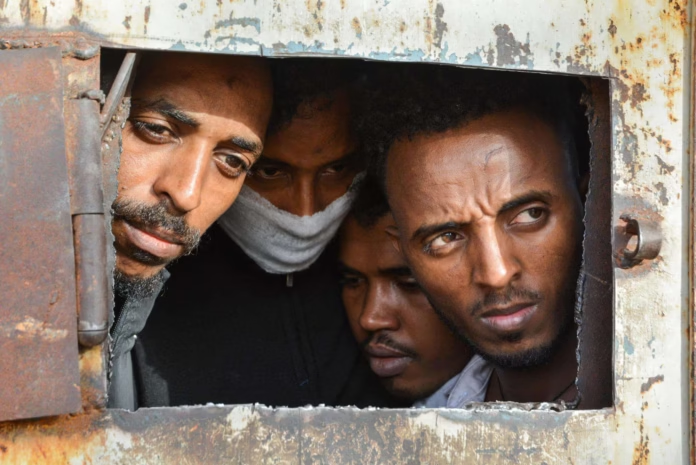
Survivor testimonies, UN investigations, and migration data reveal a system where abuse, ransom, and geopolitical policies collide
By Tuhin Sarwar
Investigative Journalist | Dhaka, Bangladesh
A Dangerous Transit Turning into a Human Rights Catastrophe
For thousands of migrant women crossing North Africa each year, Libya has become a place where hope of reaching Europe often turns into a nightmare of detention, exploitation, and sexual violence.
A recent investigation by the United Nations Support Mission in Libya and the Office of the United Nations High Commissioner for Human Rights concluded that migrants intercepted at sea and returned to Libya frequently end up inside a network of detention centres and trafficking compounds where rape, torture, and ransom extortion are routine.
The report, titled Business as Usual (February 2026), draws on nearly 100 interviews with migrants from across Africa and Asia. Investigators describe a system where sexual violence is used both as punishment and as a business model.
For women and girls travelling through Libya, the journey can become a cycle of detention, abuse, and repeated exploitation before they are eventually repatriated or attempt the dangerous Mediterranean crossing again.
The crisis has also raised difficult questions for European migration policies and the international system responsible for protecting migrants and asylum seekers.
Libya’s Migration Crossroads: From Transit Route to Detention Economy
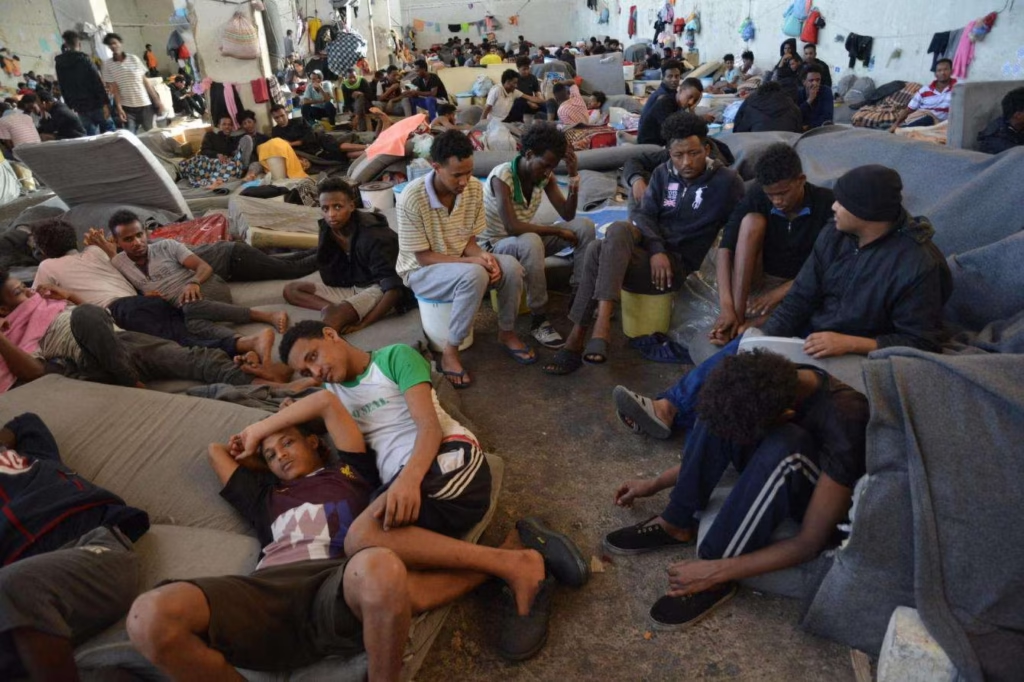
Libya has long served as a key transit point on the Central Mediterranean migration route linking sub-Saharan Africa to Europe.
After the fall of Muammar Gaddafi during the Libyan Civil War, state institutions fragmented, and armed groups gained control over large parts of the country.
Human rights organisations say this political vacuum created conditions where migrant detention became a lucrative economy for traffickers, militias, and corrupt officials.
According to the International Organization for Migration, more than 700,000 migrants from over 40 countries were estimated to be living in Libya in 2025.
Many originate from Eritrea, Sudan, Nigeria, Cameroon, and Bangladesh. Most arrive through the Sahara via Niger or Sudan, hoping to reach Europe’s southern shores.
Instead, many are intercepted by authorities or captured by trafficking networks and placed in detention facilities overseen by Libya’s Directorate for Combating Illegal Migration.
Human rights monitors say these centres often operate with little transparency and minimal oversight.
Repatriation and Return Operations: The Cycle of Interception
Migrants who attempt to cross the Mediterranean from Libya are frequently intercepted at sea and returned to the country.
These operations are often conducted by the Libyan Coast Guard with logistical and financial support from the European Union.
Data from the International Organization for Migration shows that tens of thousands of migrants have been intercepted and returned to Libya in recent years.
Many of those returned are transferred directly to detention centres where conditions have repeatedly been criticised by human rights organisations.
One Eritrean woman interviewed by UN investigators described being detained after her boat was intercepted in the Mediterranean.
“When they took us back to Libya, we knew we were returning to the same place of violence.”
She said she was later held for several months in a facility where women were repeatedly assaulted and families were forced to pay a ransom for their release.
Humanitarian organisations say the cycle of interception and return effectively traps migrants inside Libya’s detention system.
Detention and Humanitarian Crisis in Libya
Inside many detention facilities, migrants face overcrowding, limited access to food and medical care, and frequent abuse.
Investigators documented cases of women being raped by guards and by outside men brought into detention centres.
A survivor from Eritrea told investigators that girls as young as 14 were assaulted repeatedly.
“Different men raped me many times. Girls as young as fourteen were raped every day.”
Other testimonies describe women forced into prostitution or held until relatives abroad paid a ransom.
Humanitarian organisations say the absence of female guards in many facilities increases vulnerability to sexual violence.
Medical teams working with Médecins Sans Frontières have treated survivors arriving in Europe with severe physical injuries and psychological trauma linked to abuse in Libya.
Between 2023 and 2025, MSF’s rehabilitation programme in Palermo supported 160 survivors of torture. Among female patients, about 80 percent reported experiencing sexual or gender-based violence during their journey.
Doctors say pregnancies resulting from rape, untreated infections and long-term trauma are common among survivors.
EU Migration Control and the Role of Frontex
Europe’s efforts to control irregular migration in the Mediterranean have been a central part of the debate around Libya.
The European border agency Frontex provides surveillance data and coordination for maritime border operations in the region.
According to Frontex statistics, irregular crossings along the Central Mediterranean route have fluctuated significantly over the past decade, with Libya remaining one of the primary departure points.
Critics argue that cooperation between European governments and Libyan authorities has contributed to a system where migrants intercepted at sea are returned to conditions widely documented as abusive.
Human rights lawyers say such returns may violate the principle of non-refoulement, which prohibits sending individuals back to places where they face persecution or serious harm.
European officials maintain that cooperation with Libya is necessary to prevent dangerous sea crossings and combat smuggling networks.
But the policy has increasingly come under scrutiny from international organisations and courts.
Italy’s Legal Enforcement and Prosecution of Traffickers
Italy, one of the main entry points for migrants crossing the Mediterranean, has intensified legal efforts to prosecute trafficking networks linked to Libya.
Italian prosecutors have investigated multiple cases involving traffickers operating along the Libya-Italy route.
Authorities say many of these networks operate across several countries and rely on complex financial systems to collect ransom payments from migrants’ families.
In recent years, Italian courts have pursued cases against traffickers accused of organising sea crossings and running detention compounds in Libya.
Legal experts say such prosecutions are essential but difficult due to the transnational nature of trafficking networks and the limited cooperation from authorities inside Libya.
Bangladesh and the Challenge of Returning Migrants
Among the migrants passing through Libya are thousands of Bangladeshis seeking work opportunities in Europe or North Africa. Bangladesh’s government has organised repatriation flights for citizens stranded in Libya during periods of conflict and instability.
However, migrant rights advocates say returning migrants often face significant challenges once they arrive home. Many return with heavy debts incurred to finance their migration journeys. Some also carry physical injuries or trauma linked to detention and abuse during their transit.
Officials in Bangladesh have acknowledged the need for stronger monitoring of recruitment networks that send migrants through irregular routes.Yet analysts say gaps remain in enforcement and protection mechanisms.
Psychosocial Trauma and Reintegration Challenges
Survivors returning from Libya frequently experience long-term psychological effects.
Mental health specialists working with migrant returnees report symptoms including depression, post-traumatic stress disorder and severe anxiety.
Women who experienced sexual violence often face additional stigma in their communities, making reintegration more difficult. Humanitarian organisations stress the need for psychosocial support and economic assistance to help survivors rebuild their lives.
Without such support, many returnees feel pressure to attempt migration again despite the risks.
Policy Failures and Calls for Reform
Human rights groups argue that addressing the crisis requires coordinated international action.
Investigators from the Office of the United Nations High Commissioner for Human Rights have called for several urgent measures:
- Ending forced returns of migrants to Libya until detention conditions meet international standards
- Expanding independent monitoring of detention facilities
- Strengthening international prosecutions against traffickers
- Creating safer legal pathways for migration
Experts say tackling the crisis also requires addressing the economic drivers that push migrants to undertake dangerous journeys in the first place.
Conclusion: Breaking the Cycle of Abuse
For migrants trapped in Libya’s detention system, the risks extend far beyond the Mediterranean crossing itself.
Survivor testimonies, UN investigations, and humanitarian data all point to the same conclusion: detention in Libya has become part of a broader system where exploitation and violence are deeply embedded.
Until stronger protections, accountability mechanisms, and legal migration pathways are established, thousands of migrants will continue to face the same cycle of interception, detention, and abuse.
For the women who survived Libya’s detention centres, the scars—physical and psychological—often remain long after the journey ends.
References
Sources (All verifiable as of March 2026):
- UN report: Migrants in Libya victims of “violent business model” (OHCHR/UNSMIL, Feb 2026)
- UN Geneva press briefing on Libya migrant abuse (OHCHR, Feb 2026)
- 309 Bangladeshis repatriated from Libya (Bangladesh)
- 174 Bangladeshis repatriated (Libyan Platform)
- Bangladesh repatriations in Sep 2025 (Dhaka Tribune)
- 165 Bangladeshis repatriated in Mar 2026 (Jagonews)
- 123 Bangladeshi migrants repatriated (BSS)